
Executive Overview
In the landscape of early childhood education and foundational literacy development, few pedagogical hurdles are as frequently encountered—or as routinely misunderstood by developing readers—as the rules governing consonant variability. Specifically, the unpredictable acoustic behaviors of the letters c and g present a major milestone in decoding instruction. While educators and curriculum developers have long emphasized the distinction between "hard" and "soft" phonetic sounds, providing students with interactive, tactile, and engaging tools to internalize these rules remains a constant objective for literacy specialists.
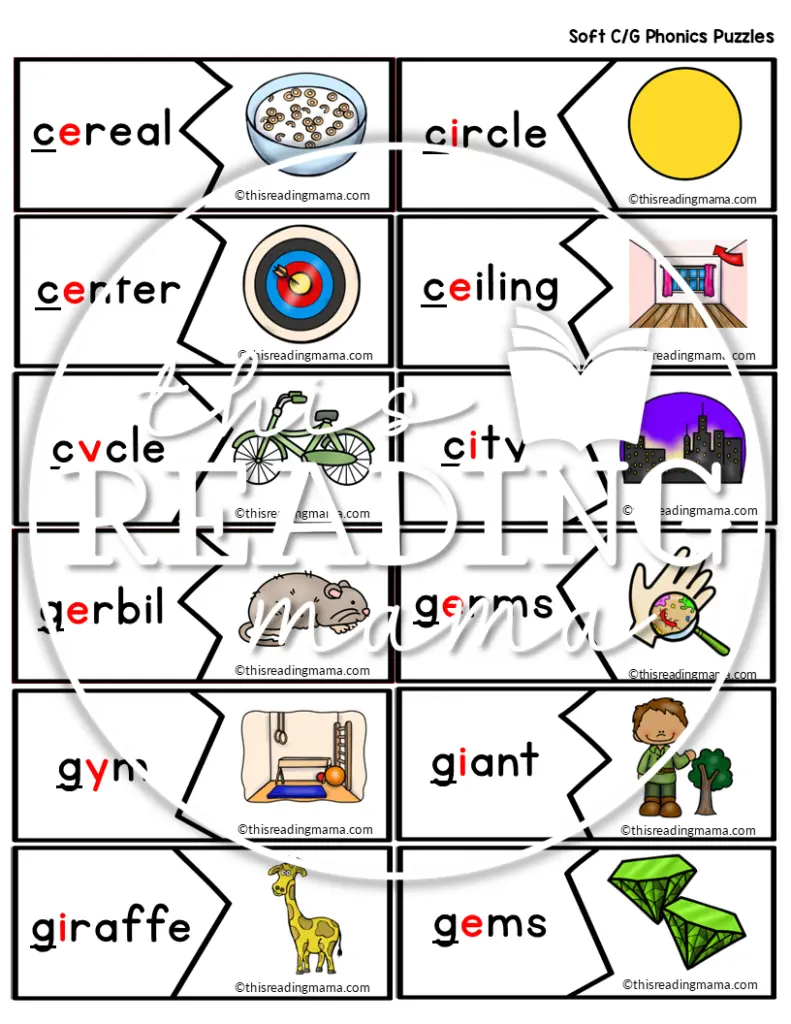
To bridge the gap between abstract phonetic theory and practical classroom application, educational resources like the newly released Soft C and G Phonics Puzzles offer targeted intervention and reinforcement. Developed by literacy advocate Becky of This Reading Mama, these free instructional aids are designed to dismantle the confusion surrounding phonemic generalizations. By incorporating multi-sensory puzzle-based learning into reading curricula, educators can effectively demystify why words like city and giraffe sound radically different from cat and goat, despite sharing initial consonant graphemes.
This comprehensive report examines the structural mechanics of soft consonant phonics, the cognitive science behind phonemic generalization, the educational utility of puzzle-based learning tools, and the broader implications for modern reading instruction.
Detailed Chronology: The Evolution of Phonics Instruction and Consonant Generalization
The Historical Shift Toward Systematic Phonics
The methods by which children are taught to read have undergone significant transformation over the past century. During the late 20th century, the pendulum swung between whole-language approaches and systematic phonics instruction. By the early 2000s, extensive empirical research—culminating in findings from the National Reading Panel—firmly established that explicit, systematic phonics instruction is the most effective pathway for teaching children how to read, particularly for struggling readers and English language learners.

Within a systematic phonics framework, decoding is taught through predictable letter-sound correspondences. However, the English language is notoriously complex, heavily influenced by historical roots originating from Old English, Latin, Norse, and French. This linguistic melting pot resulted in orthographic irregularities, among which letter-sound ambiguity stands out prominently. The letters c and g serve as prime examples of this phonetic evolution, retaining dual phonetic values depending on their historical linguistic environment.
The Milestone Development of Consonant Variability Instruction
As literacy frameworks evolved to address these irregularities, educators recognized that students could not simply memorize every word in isolation; they required clear, actionable "phonics generalizations"—rules of thumb that govern how letters behave in predictable contexts.
- Phase One: Mastery of Hard Sounds. Historically, early reading programs introduced c strictly as /k/ (as in cat, cup, cot) and g strictly as /g/ (as in goat, gum, gate). This foundational step ensured that children grasped the most statistically common baseline sounds for these consonants.
- Phase Two: Introduction of Soft Sounds. As students progressed into intermediate foundational reading (typically late first grade through second grade), educators introduced the secondary, "soft" sounds: /s/ for c (as in cent, city) and /j/ for g (as in gem, gym).
- Phase Three: Interactive Reinforcement (Present Day). Recognizing that passive memorization of these rules is insufficient for long-term retention, modern curriculum designers have pivoted toward kinesthetic and interactive learning modalities. The release of specialized instructional materials, such as the Soft C and G Phonics Puzzles, marks the ongoing refinement of making these abstract phonological rules tangible and engaging for young learners.
Supporting Context & Metrics: Decoding the Science of Hard vs. Soft Consonants
What Are Hard and Soft Consonants?
To fully appreciate the utility of phonics puzzles, one must first examine the linguistic mechanics at play.
- The Letter C: In its hard form, c produces a voiceless velar plosive sound, represented phonetically as /k/. In its soft form, it shifts to a voiceless alveolar sibilant, represented as /s/.
- The Letter G: In its hard form, g produces a voiced velar stop sound, represented as /g/. In its soft form, it transitions to a voiced palato-alveolar affricate, represented as /j/.
The Universal Phonics Generalization Rule
The critical cognitive bridge for learners is understanding when these shifts occur. Educational linguistics relies on a foundational generalization rule:

When the letters c or g are immediately followed by the vowels e, i, or y, they typically make their soft sounds.
Conversely, when c or g are followed by the vowels a, o, or u, or by another consonant, they retain their hard sounds.
Exemplar Matrix:
| Consonant | Hard Sound Context | Example | Soft Sound Context | Example |
|---|---|---|---|---|
| C | Followed by a, o, u | cat, cot, cup | Followed by e, i, y | cent, city, cyst |
| G | Followed by a, o, u | gate, goat, gum | Followed by e, i, y | gem, giant, gym |
Exceptions and Cognitive Flexibility
No English phonics rule is completely without exception, a reality that often frustrates developing readers but provides a vital lesson in cognitive flexibility. Common exceptions to the soft c and g rule include words of Germanic or Norse origin where the hard sound persists despite being followed by e or i. Prominent examples highlighted by reading specialists include gift and girl (where g is followed by i but maintains a hard /g/ sound), as well as words like get, give, and target.
Integrating puzzles that allow students to sort, manipulate, and categorize these words helps mitigate the confusion caused by anomalies, reinforcing the primary rule while acknowledging exceptions in a controlled, stress-free environment.

Official Statements and Pedagogical Perspectives
Educational experts, reading specialists, and curriculum creators consistently emphasize the importance of multi-sensory engagement in mastering complex phonics rules.
Becky, the creator behind This Reading Mama and designer of the Soft C and G Phonics Puzzles, highlights the pedagogical reasoning behind these resources:
"It doesn’t take long for learners to notice that when they happen upon the letter c or the letter g, these letters can represent more than one sound. C doesn’t always represent /k/ as in cat, and g doesn’t always represent /g/ as in goat. So how are learners to know which sound to make? By engaging them with hands-on puzzles that directly target these spelling generalizations, we transform abstract rules into interactive discoveries."
Literacy researchers concur that tactile learning experiences activate multiple neural pathways, enhancing memory consolidation. According to cognitive psychologists specializing in reading acquisition, children who manipulate physical letters, puzzle pieces, or sorting cards demonstrate superior orthographic mapping compared to those who rely solely on worksheet-based rote memorization. By physically connecting word segments that follow the e, i, y rule, students build stronger cognitive architectures for decoding unfamiliar text independently.
Future Outlook: The Direction of Foundational Literacy Tools
As educational technology and printable pedagogical resources continue to evolve, the demand for high-quality, targeted phonics intervention materials remains exceptionally high. Schools and homeschooling parents alike are placing renewed emphasis on the Science of Reading—an evidence-based body of research that underscores explicit decoding instruction over guessing strategies.
Emerging Trends in Phonics Education
- Integration of Digital and Print Hybrids: While physical puzzles and printable worksheets (such as No Prep Hard and Soft C and G Pages) remain staples of early education due to their fine-motor and tactile benefits, future iterations are increasingly optimized for hybrid learning environments, blending physical manipulation with digital tracking.
- Personalized Intervention Modules: Educators are moving toward differentiated instruction models where tools like phonics puzzles are deployed dynamically based on individual student diagnostic data. A student struggling specifically with the soft g sound in words like giant can be targeted with specialized puzzle sets rather than generalized remediation.
- Expansion of Free Accessible Resources: Platforms that offer free, high-quality, peer-tested educational printables are expected to play an increasingly vital role in bridging educational equity gaps, ensuring that classrooms with limited funding and homeschooling families have access to evidence-based literacy tools.
Conclusion
The journey from a pre-reader to a fluent, confident decoder is paved with complex linguistic rules, subtle phonetic nuances, and occasional irregularities. Resources like the Soft C and G Phonics Puzzles represent more than mere classroom diversions; they are scientifically aligned instruments designed to reinforce foundational decoding skills. By grounding interactive play in solid phonics generalizations, educators can empower the next generation of readers to navigate the intricacies of the English language with clarity, precision, and enduring confidence.

