The narrative surrounding enterprise artificial intelligence has undergone a fundamental transformation. For the past several years, the race to adopt generative AI was defined by a singular, overarching constraint: the availability and capability of foundational large language models (LLMs). Organizations scrambled to secure access to the most advanced AI models, measuring their technological readiness by parameter counts, compute budgets, and inference speeds.
However, as AI rapidly evolves from passive chat interfaces to autonomous, action-oriented agentic AI, the primary engineering constraint has shifted dramatically. The bottleneck is no longer in the models; it is in the plumbing.
According to the newly released 2026 State of AI in the Enterprise report—commissioned by cloud content management leader Box and conducted by The Harris Poll—AI agents have successfully crossed the chasm into mainstream enterprise operations. Yet, the foundational content infrastructure, data governance frameworks, and security protocols required to support them are severely lagging.
The empirical findings of the report paint a stark picture of an industry moving at two different speeds. While 83% of surveyed organizations report that they are actively running AI agents, a mere 36% of those utilizing or experimenting with the technology have successfully connected their agents to trusted internal content across multiple use cases. Furthermore, nearly half of all participating organizations have already experienced at least one AI-related data exposure incident. Alarmingly, only 34% have instituted formal, enterprise-wide standards to govern how these autonomous agents access, read, and manipulate sensitive corporate information.
This investigative report explores the core findings of the Box study, dissecting the widening chasm between AI deployment velocity and data infrastructure maturity. We analyze the shift from raw model capability to contextual relevance, examine the plumbing and security breakdowns plaguing modern enterprises, and outline the strategic roadmap organizations must adopt to secure their knowledge repositories for the age of autonomous agents.
Detailed Chronology and Research Methodology
To understand the current state of enterprise AI readiness, it is essential to examine the parameters of the research that brought these vulnerabilities to light. Commissioned by Box and executed via an independent survey by The Harris Poll, the data reflects a comprehensive cross-section of the global enterprise technology landscape.
The survey methodology targeted 1,640 IT decision-makers distributed across four major economic regions: the United States, the United Kingdom, France, and Japan. Fielded between April 30 and May 8, the research captured insights from leaders who are directly responsible for designing, deploying, and securing enterprise technology stacks.
The Evolution of the Survey Findings
Late April to Early May: The Harris Poll fields the global survey of 1,640 IT decision-makers across the US, UK, France, and Japan on behalf of Box.
Mid-2026: Box officially releases the 2026 State of AI in the Enterprise report, accompanied by specialized chapters focusing on enterprise context and the emerging operational bottlenecks.
Current Landscape: Enterprises grapple with the operational reality highlighted in the report: while agentic AI deployment accelerates, fragmented data silos and inadequate permissions architectures expose firms to unprecedented security and compliance risks.
The findings dismantle the early assumption that deploying AI is merely a software integration task. Instead, the research underscores that AI agents are organizational mirrors. They expose existing data hygiene issues, fragmented legacy systems, and loose access controls, magnifying structural enterprise weaknesses at machine speed.
Supporting Context & Metrics: The Anatomy of the Agentic AI Gap
The transition from traditional generative AI chatbots to agentic workflows represents a paradigm shift in how software interacts with corporate data. Unlike a static LLM that answers prompts based on generalized training data, an AI agent is designed to execute multi-step workflows, make decisions, interact with external systems, and generate actionable outcomes.
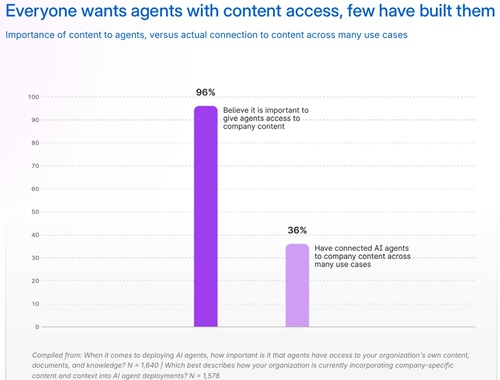
To perform these tasks effectively, agents require deep, real-time access to enterprise context. As the report’s chapter on enterprise context reveals, 96% of surveyed organizations agree that it is either important or very important for AI agents to access internal content and corporate knowledge.
Yet, this universal recognition of value collides with a severe implementation deficit.
[The Agentic AI Readiness Disconnect]
-----------------------------------------------------------------
96% of organizations: Acknowledge AI agents need internal content access
83% of organizations: Are actively running or experimenting with AI agents
36% of organizations: Have connected agents to trusted internal content
34% of organizations: Have established formal agent governance standards
42% of leading orgs:  Successfully bridge content to multi-use-case agents
17% of early orgs:    Successfully bridge content to multi-use-case agents
-----------------------------------------------------------------
The Maturity Divide
The research reveals a stark polarization between digitally mature enterprises and those lagging behind:
Leading-Edge Organizations: Among organizations classifying themselves as advanced or leading-edge adopters, 42% have successfully connected agents to trusted internal content across a broad spectrum of use cases. These firms treat their unstructured data as a dynamic workspace rather than a static filing cabinet.
Early-Stage Organizations: Conversely, only 17% of early-stage organizations have achieved the same level of integration. This group remains stuck in pilot purgatory, constrained by data silos, cultural inertia, and legacy architecture.
Redefining the Document
The Box report emphasizes that unstructured content—including legal contracts, financial reports, operational documentation, and customer communications—is undergoing an existential evolution. Traditionally viewed as passive repositories designed for human retrieval, documents are rapidly transforming into active working environments.
In this new paradigm, AI agents do not merely read files; they traverse them, extract insights, write updated results back into the system, preserve institutional context, and collaborate seamlessly with human workers or other specialized sub-agents.
However, achieving this level of operational fluidity requires far more than implementing a semantic search engine or a basic vector database. It demands a rigorous infrastructure built on unified identity management, granular permissions, continuous auditing, and robust governance controls. Without these guardrails, giving autonomous software agents write and read access to corporate repositories becomes an uncalculated operational hazard.
The Problem Is in the Plumbing: Security, Compliance, and Data Fragmentation
While executives recognize the necessity of feeding context to their AI initiatives, the technical mechanics of doing so are fraught with friction. The report categorizes the primary barriers holding organizations back into a complex web of security, architectural, and data management challenges.
1. Security, Privacy, and Regulatory Compliance
At the apex of enterprise hesitation sit existential anxieties regarding data protection.
Security and Privacy Concerns: Cited by 38% of respondents, this remains the single largest deterrent to connecting autonomous agents with internal organizational data. IT leaders fear unauthorized data leakage, model poisoning, or malicious prompt injection attacks that could trick agents into exfiltrating proprietary assets.
Regulatory and Compliance Obligations: Selected by 29% of respondents, strict global regulatory frameworks—such as the European Union Artificial Intelligence Act, GDPR, HIPAA, and various financial compliance mandates—make organizations hesitant to grant autonomous systems broad access to regulated data streams.
2. Architectural and Infrastructure Friction
Beneath these headline risks lie systemic engineering bottlenecks that have accumulated over decades of enterprise IT expansion:
Fragmented Data Across Systems (25%): Corporate knowledge is rarely centralized. It is scattered across disparate SaaS applications, legacy on-premises servers, siloed cloud buckets, and departmental drives, making it difficult for an agent to construct a unified view of the enterprise.
Integration Difficulties (24%): Integrating modern AI APIs and agent orchestration frameworks into legacy enterprise resource planning (ERP), customer relationship management (CRM), and content management systems (CMS) requires specialized engineering talent and custom middleware.
Missing Permissions and Access Controls (21%): Many organizations discover that their existing access control lists (ACLs) are outdated, overly permissive, or poorly enforced. When an AI agent inherits broad user permissions, it can inadvertently surface confidential HR records or executive compensation data to unauthorized employees.
Poorly Organized or Classified Content (18%): Decades of digital hoarding have left enterprise networks cluttered with untagged, duplicate, or unclassified files. Without robust metadata and data taxonomy, agents struggle to determine the authority and accuracy of the documents they process.
Poor or Outdated Content Quality (16%): Outdated documentation, conflicting policy versions, and obsolete drafts poison the retrieval-augmented generation (RAG) pipelines that agents rely on, leading to "hallucinations" grounded in bad internal data.
Official Insights: Bridging the Context Gap
The findings of the Box-commissioned study highlight an urgent call to action for CIOs, CISOs, and enterprise architects. As the report succinctly observes:
"If the first phase of enterprise AI was defined by access to models, the next is defined by access to context."
Industry analysts note that enterprises can no longer rely on superficial solutions. Buying a powerful frontier model from an AI lab is no longer a strategic differentiator; it is a commodity. The true competitive advantage lies in an organization’s internal plumbing—how cleanly its data is structured, how securely its identity and access management (IAM) protocols are enforced, and how effectively its governance frameworks oversee autonomous machine activity.
To operationalize these insights safely, IT leaders must transition from a reactive posture—where security policies are bolted on after a data exposure incident occurs—to a proactive architecture where content infrastructure and AI governance are co-developed.
Future Outlook: The Roadmap for Enterprise AI Maturity
As organizations look toward the remainder of the decade, the success of their agentic AI deployments will depend entirely on their willingness to modernize their content infrastructure. The race for model supremacy is giving way to a more pragmatic, foundational race: the optimization of enterprise context.
To bridge the gap between enthusiastic adoption (83%) and secure, scaled implementation (36%), enterprises must execute a strategic transformation across four key pillars:
1. Unify and Centralize Data Silos
Organizations must consolidate fragmented repositories or deploy robust federation layers that allow AI agents to query multi-cloud and on-premises environments securely. Content must be aggregated into trusted, searchable repositories that maintain a single source of truth.
2. Modernize Identity and Access Management (IAM)
Before granting autonomous agents access to corporate documents, IT departments must audit and tighten user permissions. Role-based access control (RBAC) and attribute-based access control (ABAC) must be rigorously applied to ensure that AI agents operate under the exact same least-privilege principles mandated for human employees.
3. Implement Automated Content Governance and Hygiene
Cleaning up legacy data is no longer optional. Enterprises must leverage automated classification tools, metadata tagging engines, and lifecycle management policies to purge obsolete files, resolve conflicting document versions, and ensure that agents only ingest verified, high-quality information.
4. Establish Formal Agent Governance Frameworks
With only 34% of organizations currently maintaining formal standards for agent access, the establishment of cross-functional AI governance boards is paramount. These frameworks must define auditing protocols, monitor agent behavior, trace decision-making pathways, and establish rapid incident-response mechanisms to mitigate data exposure risks.
Ultimately, the agentic AI revolution will not be won by the organizations with the largest compute clusters, but by those with the cleanest, best-governed, and most accessible institutional knowledge. The plumbing must be fixed before the floodgates of autonomy can be safely opened.