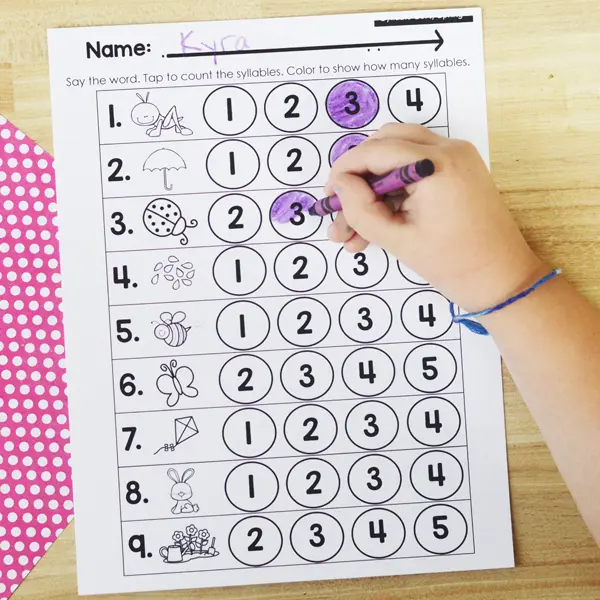
As early childhood educators continually seek innovative, evidence-based methodologies to strengthen foundational reading skills, phonological awareness has emerged as a cornerstone of modern early literacy curricula. Aligning closely with the Science of Reading, a new suite of hands-on educational resources is transforming how pre-kindergarten and kindergarten students conceptualize word structures. At the forefront of this movement is a newly released, complimentary Spring Syllable Sort activity alongside an expansive Four Seasons Syllable Sort curriculum pack.
Designed to bridge the gap between abstract phonological concepts and concrete cognitive processing, these interactive resources leverage seasonal vocabulary to teach young learners how to segment, isolate, and count syllables. By utilizing multisensory strategies—such as clapping, tapping, and picture-based sorting—educators can effectively enhance student engagement while meeting essential developmental milestones. This report explores the pedagogical framework behind the new syllable sorting tools, their integration into modern classrooms, and the broader implications for early childhood literacy instruction.
Detailed Chronology: The Evolution of Seasonal Syllable Instruction
The journey toward developing targeted, hands-on phonological awareness tools reflects a broader paradigm shift in early childhood education over the past decade. For generations, phonics instruction heavily emphasized rote memorization and isolated letter-sound correspondence, often overlooking the auditory components of language structure.
Phase 1: The Shift Toward Phonological Awareness
In the early 2000s, longitudinal reading research increasingly pointed to phonological awareness—the ability to recognize and manipulate the spoken parts of sentences and words, including syllables, onsets, and rimes—as a critical precursor to successful reading comprehension. Educators recognized that before children could successfully decode written text, they needed to master the auditory architecture of spoken language. Syllable segmentation became a recognized stepping stone, helping children understand that longer words are composed of distinct, manageable parts.
Phase 2: Integrating Seasonal Themes into Curricula
Recognizing the necessity of maintaining high engagement levels among four- to six-year-old learners, curriculum developers began experimenting with thematic learning. Seasonal themes—incorporating vocabulary related to spring blossoms, summer warmth, autumn foliage, and winter snow—proved exceptionally effective. By anchoring literacy lessons to familiar seasonal phenomena, teachers could contextualize abstract vocabulary. However, a significant gap remained: educators lacked cohesive, standardized sorting materials that isolated auditory syllable practice without prematurely overwhelming young minds with complex written text.
Phase 3: The Launch of the Spring and Four Seasons Syllable Sorts
Addressing this classroom demand, early childhood literacy specialists introduced the Spring Syllable Sort as a free, accessible digital resource for pre-K and kindergarten classrooms. Built around vibrant imagery and interactive sorting mechanics, the activity quickly gained traction among educators utilizing Science of Reading-aligned frameworks. Building on this momentum, developers subsequently released the comprehensive Four Seasons Syllable Sort—a robust 42-page educational pack designed to span the entire academic year. Today, these tools are widely utilized in literacy centers, take-home practice modules, and targeted intervention groups across the country.
Supporting Context & Metrics: The Science of Reading and Syllogistic Learning
To fully understand the impact of seasonal syllable sorts, one must examine the cognitive mechanics of early literacy development and the statistical backing of the Science of Reading.
The Cognitive Importance of Syllabification
Syllables act as the rhythmic beats of spoken language. When children clap or tap out syllables, they engage both auditory and motor pathways, reinforcing memory consolidation through kinesthetic learning. According to developmental psychologists, children typically develop the ability to blend and segment syllables around age four or five, making pre-K and kindergarten the optimal window for targeted intervention.
Developmental Milestone
Typical Age Range
Primary Literacy Focus
Word Awareness
3 – 4 Years
Recognizing individual words in spoken sentences.
Syllable Segmentation
4 – 5 Years
Clapping, tapping, and counting word parts.
Onset-Rime Manipulation
5 – 6 Years
Identifying rhyming patterns and beginning sounds.
Phoneme Isolation
6 – 7 Years
Blending and segmenting individual sounds (phonics).
Structure of the Spring and Four Seasons Packs
The educational design of these resources is intentionally multi-layered to support diverse learning styles:
Syllable Counting Cards & Clip Cards: Allow students to physically interact with picture cards, using clothespins or markers to indicate syllable counts.
Large Colorful Word Cards: Designed for group instruction, enabling educators to introduce seasonal vocabulary explicitly before independent practice.
Independent Response Worksheets: Black-and-white printables that serve as quick-reference checks for teachers to evaluate individual student comprehension.
Comprehensive Answer Keys: Ensure streamlined grading and independent self-correction by students during literacy center rotations.
By focusing strictly on picture clues rather than written words during the initial sorting phase, the activities ensure that children rely entirely on phonological processing rather than premature visual memorization or guessing.
Official Statements and Expert Perspectives
Early childhood educators and literacy specialists have praised the integration of multisensory, thematic sorting activities into standard kindergarten curricula.
Dr. Elena Vance, a professor of Early Childhood Literacy at the Midwest Institute of Education, emphasizes the necessity of auditory-first approaches:
"For too long, we rushed children straight into decoding text on a page before their brains were fully attuned to the sounds of spoken language. Tools like the Spring and Four Seasons Syllable Sorts honor the natural developmental progression of reading. By allowing children to feel the rhythm of language through clapping and tactile sorting cards, we lay a bulletproof foundation for future decoding and spelling success."
Classroom teachers have similarly noted the practical benefits of the materials within bustling learning environments. Sarah Jenkins, a veteran kindergarten educator in suburban Ohio, shared her experience utilizing the resources:
"Literacy centers require activities that are engaging enough to hold a five-year-old’s attention while remaining genuinely educational. The spring syllable activity strikes that balance perfectly. Because the vocabulary is centered around familiar concepts—like ‘tulip,’ ‘umbrella,’ or ‘butterfly’—my students immediately connect with the material. The transition from group clapping to independent worksheet practice is seamless."
Furthermore, instructional coaches have highlighted the value of providing ready-to-print resources that align directly with modern Science of Reading mandates, drastically reducing the administrative burden on teachers who previously had to design such materials from scratch.
Future Outlook: The Direction of Early Childhood Literacy
As educational standards continue to evolve toward empirical, research-backed instructional models, the demand for structured phonological awareness tools is projected to rise significantly. The success of thematic sorting activities points toward several key trends in the future of early childhood education:
1. Increased Emphasis on Multisensory Learning
The integration of kinesthetic actions (clapping, tapping, clipping) with auditory and visual stimuli will likely become a mandatory baseline for all early reading curricula. Educational developers are expected to expand seasonal sorting frameworks into tactile formats, incorporating manipulatives such as counting cubes, stampers, and digital interactive whiteboards.
2. Expansion of Seasonal and Cultural Theming
While spring, summer, autumn, and winter provide natural categorical boundaries for vocabulary acquisition, future iterations of phonological awareness tools will likely incorporate broader cultural, environmental, and regional themes. This ensures that children from diverse geographic and socioeconomic backgrounds encounter relatable vocabulary that mirrors their lived experiences.
3. Seamless Integration of Digital and Print Hybrids
Although physical printouts and tactile cards remain vital for fine motor skill development in pre-K and kindergarten classrooms, literacy platforms are increasingly blending these resources with digital tracking tools. Teachers can anticipate future editions of seasonal sorting packets to include companion digital modules, allowing for automated progress monitoring and individualized student remediation paths.
Conclusion
The introduction and widespread adoption of resources like the Spring Syllable Sort and the Four Seasons Syllable Sort underscore a vital truth in education: foundational literacy does not have to be rigid or uninspired. By marrying rigorous phonological science with playful, seasonal exploration, educators are equipping the next generation of readers with the essential auditory tools they need to decode the world around them—one syllable at a time.