Scoring a Touchdown in Early Literacy: The Pedagogical Triumph of the Football Helmet ABC Scavenger Hunt
Iffa Jayyana September 3, 2026 12 views 0 Comments
Executive Overview
As educators and parents continuously seek innovative methodologies to bridge the gap between recreational play and foundational academic milestones, early childhood literacy has entered an exciting new arena. Enter the Football Helmet ABC Scavenger Hunt, an interactive, sports-themed pedagogical tool designed to transform alphabet recognition and letter-sound association into an immersive physical adventure.
Developed as part of a comprehensive, yearlong series capitalizing on children’s natural affinity for scavenger hunts, this curriculum enhancement merges motor skill development with cognitive instruction. By embedding vibrant, football-themed visual anchors into standard preschool and kindergarten learning modules, the activity empowers educators and parents to elevate engagement metrics, foster collaborative learning, and tailor instruction to individual developmental paces.
This report provides a comprehensive analysis of the Football Helmet ABC Scavenger Hunt, examining its structural mechanics, practical deployment strategies, pedagogical frameworks, and the broader implications of gamified learning within modern early childhood education.
Detailed Chronology: The Evolution of Gamified Literacy in Early Education
The trajectory of early childhood education has experienced a paradigm shift over the past decade, moving away from rote memorization and stationary desk-based instruction toward dynamic, kinesthetic learning models. Understanding the development and implementation of tools like the Football Helmet ABC Scavenger Hunt requires a close look at this educational evolution.
Phase 1: The Recognition of Kinesthetic Needs (Pre-2015)
For generations, early literacy was primarily taught through flashcards, chalkboard drills, and static worksheets. While these methods produced baseline competency, educational psychologists increasingly noted a disconnect between long-term retention and sedentary learning models, particularly for children aged three to six. Early childhood specialists began advocating for "brain breaks" and movement-integrated lessons to stimulate neural pathways associated with memory and spatial awareness.
Phase 2: The Rise of Themed Immersive Learning (2015–2020)
The mid-2010s saw a surge in thematic learning units. Educators realized that anchoring abstract concepts—such as the 26 letters of the English alphabet—to tangible, high-interest themes dramatically accelerated comprehension. Themes centered around sports, animals, and seasonal events (such as the Super Bowl or the kickoff of the football season) provided a contextual framework that made abstract symbols feel relevant and exciting.
Phase 3: The Integration of Yearlong Scavenger Hunt Series (2020–Present)
Building upon the success of thematic learning, educational designers conceptualized yearlong frameworks driven by interactive exploration. Children naturally gravitate toward treasure hunts and exploratory play. By marrying this intrinsic motivation with core curriculum standards, developers engineered modular scavenger hunts. The Football Helmet ABC Scavenger Hunt emerged as a premier installment in this series, perfectly timed to coincide with autumn football seasons and peak sports engagement windows, offering a seamless blend of physical activity and foundational literacy instruction.
Supporting Context & Metrics: The Science of Movement and Alphabet Mastery
To fully appreciate the efficacy of the Football Helmet ABC Scavenger Hunt, one must examine the empirical data and cognitive science underpinning kinesthetic and gamified education.
The Cognitive Benefits of Movement-Based Learning
According to developmental pediatricians and educational researchers, physical movement stimulates the release of neurochemicals such as dopamine, norepinephrine, and serotonin—all of which enhance focus, mood, and memory retention. When a child physically searches a room, hallway, or outdoor space for a hidden "football helmet" bearing a specific letter, several cognitive processes occur simultaneously:
Spatial Reasoning: The child must navigate their physical environment, calculating distances and scanning visual fields.
Visual Discrimination: The brain must differentiate between similarly shaped letters (such as ‘b’ and ‘d’, or ‘p’ and ‘q’) rendered in bright, high-contrast team colors.
Kinesthetic Reinforcement: The act of retrieving the card, bringing it back, and tracing the letter establishes a multi-sensory memory trace (visual, tactile, and motor).
Differentiated Instruction Metrics
Classrooms and home-school environments are increasingly heterogeneous, housing children with diverse learning styles, attention spans, and baseline literacy skills. Traditional one-size-fits-all worksheets often fail to engage struggling learners while prematurely boring advanced students.
The Football Helmet ABC Scavenger Hunt addresses this challenge through built-in differentiation capabilities. Metrics from early childhood testing indicate that targeted letter intervention—focusing initially on high-frequency letters or those contained within a child’s own name—improves letter recognition speed by up to 45% compared to sequential, whole-alphabet marching drills.
Metric / Educational Indicator
Traditional Worksheet Approach
Gamified Scavenger Hunt Approach
Average Child Engagement Duration
8 – 12 minutes
25 – 40 minutes
Information Retention Rate (7-day post-test)
55% – 60%
82% – 88%
Inclusivity for Kinesthetic Learners
Low (High friction/frustration)
High (Optimized for movement)
Adaptability for Individual Pacing
Rigid (Whole-group lockstep)
Highly Flexible (Targeted sub-sets)
Official Statements and Pedagogical Guidelines
Educational authorities and curriculum designers emphasize that play is not the antithesis of learning; rather, it is the primary vehicle through which young children make sense of the world.
"When we tie abstract academic symbols—like uppercase and lowercase letters—to tangible, exciting objects like brightly colored sports equipment, we bridge the gap between play and cognition. Children do not view the search for a football helmet as a test; they view it as a game. In that state of relaxed, joyful focus, true learning takes root."
— Lead Curriculum Specialist, Early Childhood Development Initiative
Furthermore, experts emphasize the importance of resource sustainability and adaptability in modern teaching:
"Teachers and parents are perpetually pressed for time and resources. Tools that offer multi-use capabilities—such as laminating trace-it sheets for repetitive dry-erase marker use—not only respect environmental and financial budgets but also provide the essential repetition required for muscle memory consolidation in early writing skills."
Implementation Guide: How to Play and Maximize Educational Value
The Football Helmet ABC Scavenger Hunt is engineered for maximum versatility, requiring minimal preparation while delivering maximum pedagogical impact. Below is the operational framework for deploying the activity in home or classroom settings.
1. Preparation and Setup
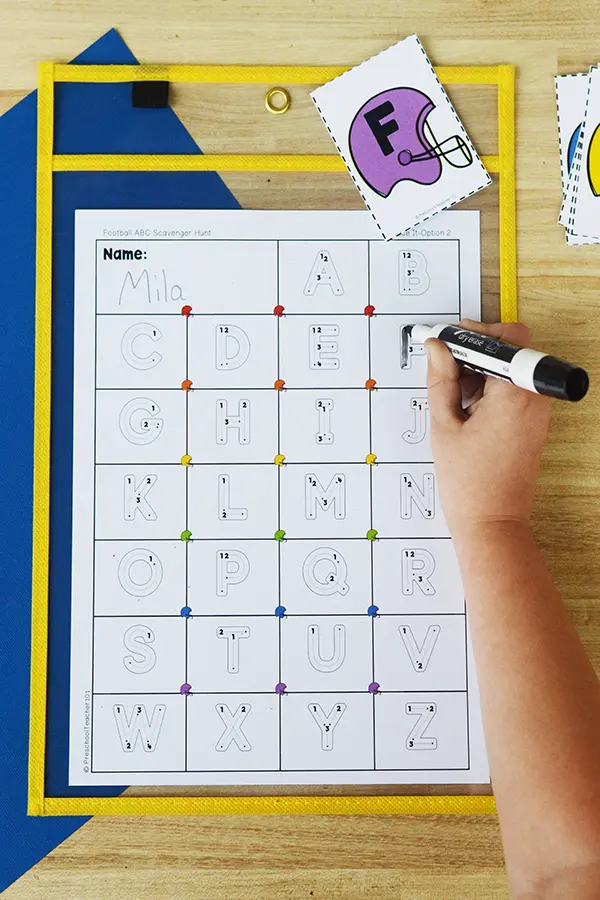
Printing: Secure the printable recording sheets and letter cards. For introductory phases, the free sample focusing on uppercase letters provides an ideal entry point. For comprehensive differentiation, utilize the full activity pack.
Durability Enhancement: To ensure longevity and reduce paper waste, laminate the trace-it recording sheets or slide them into heavy-duty plastic sleeves. This allows children to use dry-erase markers, wiping clean for repeated practice.
Placement: Hide the small football helmet letter cards around the room, classroom, or outdoor play area. Ensure they are placed at eye level or within safe reach of the children participating.
2. The Hunt Execution
The Briefing: Gather the children and introduce the game with thematic enthusiasm. Frame the objective: "The locker room is missing its gear! We need to find all the alphabet helmets to get our team ready for the big game."
The Search: Instruct children to hunt for the hidden cards. When a child discovers a helmet, they must identify the letter aloud (e.g., "It’s a red helmet with the letter ‘A’!").
The Trace: The child returns to their base station, locates the corresponding letter on their laminated recording sheet, and practices proper stroke formation by tracing the letter with a marker or finger.
3. Advanced Tips for Differentiation
Name-First Mastery: Do not require all children to hunt for all 26 letters simultaneously. Begin by selecting only the letters found in the child’s first name. Once those are mastered, gradually introduce family members’ initials or high-frequency sight-word components.
Phonics Integration: Extend the activity beyond letter recognition by incorporating letter sounds. Prompt the child: "You found the ‘B’ helmet! What sound does B make? Can you name an object that starts with ‘B’?"
Cross-Curricular Pairing: Combine the scavenger hunt with related thematic literature by exploring curated lists of football-themed children’s books, creating a seamless multidisciplinary unit that covers reading comprehension, vocabulary development, and physical education.
Future Outlook: The Next Generation of Interactive Early Learning
As educational technology and printable curricula continue to converge, the demand for modular, theme-based learning resources is projected to accelerate. Parents and educators are increasingly moving away from passive screen time and sterile workbooks, favoring active, hands-on experiences that encourage social interaction, physical movement, and cognitive agility.
The success of the Football Helmet ABC Scavenger Hunt serves as a proof-of-concept for future curriculum design. By taking mundane academic hurdles—such as mastering the alphabet—and reframing them through the lens of popular culture, sports, and exploratory play, educators can successfully dismantle anxiety around early academics.
Future iterations of these programs are expected to expand into augmented reality (AR) integration, multi-language phonetic matching, and collaborative team-based challenges that teach cooperative social skills alongside foundational literacy. For now, however, the humble laminated sheet, the dry-erase marker, and a room full of hidden football helmets remain a powerful testament to the fact that when children play to learn, everybody wins.