

Executive Overview
The corporate race to adopt Artificial Intelligence has hit a profound structural wall. While enterprises have successfully integrated generative AI models into mainstream operations with unprecedented speed, the underlying digital plumbing—specifically institutional content infrastructure, identity management, permissions, and robust governance frameworks—has fundamentally lagged behind.
According to the comprehensive 2026 State of AI in the Enterprise report released by cloud content management leader Box, autonomous and semi-autonomous AI agents are rapidly becoming standard operational fixtures in modern corporations. Yet, this high adoption rate masks a perilous operational deficit: enterprises are deploying highly capable, autonomous software agents while leaving them starved of reliable, secure access to the very internal institutional knowledge they need to function safely and effectively.
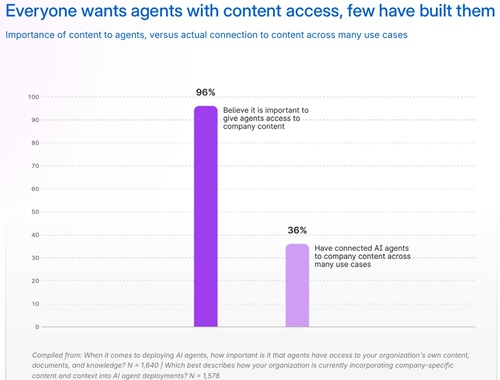
Commissioned by Box and conducted by The Harris Poll, the global study surveyed 1,640 IT decision-makers across the United States, United Kingdom, France, and Japan between April 30 and May 8. The data paints a startling picture of an enterprise ecosystem caught mid-transition. While 83% of organizations report that they are actively running AI agents, a mere 36% of those utilizing or experimenting with the technology have successfully connected these agents to trusted internal content across multiple operational use cases.
Even more alarming from a risk-management perspective, nearly half of all surveyed organizations have already experienced an AI-related data exposure incident. Despite this high incidence of security failures, only 34% of enterprises have established formal, organization-wide standards governing how software agents access, process, and store sensitive internal information.
The core thesis emerging from the 2026 report marks a definitive philosophical shift in enterprise technology: raw access to increasingly sophisticated Large Language Models (LLMs) is no longer the primary constraint or competitive differentiator. Instead, the central challenge has shifted entirely to context. Organizations are now forced to confront the arduous task of structuring their chaotic institutional knowledge and building the sophisticated integration, identity, permissions, and governance infrastructure required to let autonomous agents use that data securely.

The Shift From Models to Context: A Paradigm Disconnect
For the past several years, the corporate conversation surrounding artificial intelligence was dominated by model capability. Businesses obsessed over parameter counts, reasoning benchmarks, inference speeds, and foundation model provider selection. However, the 2026 research indicates that the enterprise AI conversation has officially evolved from a preoccupation with models to an obsessive focus on context.
In the chapter of the report dedicated explicitly to enterprise context, a staggering 96% of organizations affirmed that it is important or very important for AI agents to have seamless access to internal corporate content and knowledge bases. Executives universally understand that an AI agent operating in a vacuum—or relying solely on its pre-trained public weights—is of limited utility when trying to draft bespoke customer contracts, analyze internal financial health, or summarize proprietary research.
Yet, this universal recognition of the need for context collides sharply with operational reality, creating a massive execution gap. This chasm between aspiration and execution is particularly pronounced when comparing organizations at different stages of digital maturity. Among organizations self-identifying as being on the "leading edge" of AI adoption, 42% have successfully connected agents to trusted internal content across numerous use cases. In stark contrast, only 17% of early-stage organizations have managed to bridge this divide.
"If the first phase of enterprise AI was defined by access to models, the next is defined by access to context," the report declares, succinctly summarizing the strategic pivot facing CIOs and CTOs globally.
This transition requires a fundamental re-imagining of what enterprise content actually is. Historically, documents, contracts, unstructured reports, spreadsheets, and wikis have been treated as passive repositories—static files tucked away in folder hierarchies, SharePoint sites, or legacy file shares where humans retrieved them manually.
In the era of agentic AI, this paradigm is obsolete. Unstructured content is rapidly evolving into dynamic working environments. In these next-generation workflows, AI agents must be able to read incoming information in real-time, write analytical results back to systems, preserve critical contextual metadata, and actively collaborate alongside human workers or other specialized software agents.
Achieving this level of fluid interaction requires far more than merely throwing all corporate files into a unified search index or a basic Retrieval-Augmented Generation (RAG) pipeline. Enterprise agents must operate under strict, granular permissions, continuous governance, and rigorous auditing controls that match or exceed the security protocols protecting traditional human-facing information systems. Without these guardrails, giving autonomous agents free-roaming access to enterprise file systems is an open invitation to catastrophic data leaks, intellectual property theft, and compliance violations.
Detailed Chronology: The Rapid Rise of Agents vs. The Stagnant Plumbing
To understand how enterprises arrived at this precarious juncture, it is necessary to examine the rapid chronology of the current AI boom and the structural bottlenecks that accompanied it.
Phase 1: The Frontier Model Gold Rush (2023–2024)
Following the public explosion of generative AI, organizations rushed headlong into proof-of-concept projects. The primary goal during this initial phase was simply demonstrating that foundation models could generate useful text, write functional code, or summarize long emails. Enterprises focused almost exclusively on application programming interface (API) connectivity to cloud-based LLM providers. Data security during this phase was largely handled through simple data-loss prevention (DLP) blocks or ad-hoc exclusions, preventing employees from pasting sensitive source code or PII directly into public chat windows.
Phase 2: The Agentic Revolution (2025–Early 2026)
As foundation models matured into reasoning engines capable of multi-step planning, tool use, and autonomous execution, enterprises quickly graduated from static chat interfaces to "agentic" architectures. AI agents were deployed to automate complex workflows—such as onboarding employees, processing insurance claims, or executing multi-system code deployments.
However, because the velocity of software development vastly outpaced the pace of enterprise architecture overhaul, organizations rushed to deploy these agents without building out the requisite underlying plumbing. They connected powerful reasoning engines to legacy repositories, fragmented cloud storage systems, and unvetted databases.
The Current Crisis: The Reality Check (Mid-2026)
The release of the Box and Harris Poll data in mid-2026 marks the official reckoning of this architectural oversight. With 83% of organizations now deploying AI agents, the chickens have come home to roost. Nearly half of all enterprises have already suffered an AI-related data exposure incident—ranging from agents inadvertently surfacing confidential HR compensation files to unauthorized contractors, to hallucinations leading to the exposure of internal API keys stored insecurely in shared documents.

The industry is now waking up to the sobering realization that adding more intelligent reasoning models will not solve problems born from poor data hygiene, fragmented permissions, and non-existent content governance.
Supporting Context & Metrics: The Anatomy of the Plumbing Problem
When IT decision-makers are pressed on why they struggle to connect AI agents to internal knowledge bases, a complex matrix of security fears and technical debt emerges. The Box report breaks down these barriers, providing a clear roadmap of the infrastructure failures plaguing modern enterprises.
At the very top of the list are foundational anxieties surrounding risk:
- Security and Privacy Concerns: Cited by 38% of respondents, this remains the single most prominent psychological and technical barrier preventing organizations from unleashing agents across their content repositories.
- Regulatory and Compliance Concerns: Cited by 29% of respondents, highlighting the immense pressure corporations face under frameworks like GDPR, HIPAA, EU AI Act, and emerging global data sovereignty laws.
Beneath these headline risks, however, lie deep-seated structural and data-management dysfunctions that rarely receive adequate executive attention until an incident occurs:
[Primary AI Integration & Content Challenges Reported by IT Leaders]
------------------------------------------------------------------
Security & Privacy Concerns              ████████████████████ 38%
Regulatory & Compliance Concerns         █████████████ 29%
Data Fragmented Across Systems           ███████████ 25%
Difficulty Integrating AI Systems        ██████████ 24%
Missing Permissions / Access Controls    █████████ 21%
Poorly Organized / Classified Content    ████████ 18%
Poor / Outdated Content Quality          ███████ 16%
This granular breakdown reveals that the "plumbing" problem is multifaceted. Data fragmentation is a chronic condition in the modern enterprise; information is scattered haphazardly across SaaS applications, legacy on-premises servers, local employee drives, and departmental cloud buckets. When an AI agent attempts to synthesize information for a cross-functional project, it frequently hits these organizational silos or falls victim to inconsistent access controls.
Furthermore, missing or misconfigured permissions create massive vulnerability windows. If a legacy folder structure contains outdated ACLs (Access Control Lists) inherited from organizational restructurings years ago, an AI agent granted broad access to that folder will inherit those flaws. It will rapidly read, process, and potentially output sensitive data that human employees may have forgotten existed or never had clearance to view in the first place.

Compounding this is the persistent plague of poorly organized, unclassified, and outdated content. For decades, organizations treated digital storage as an infinite dumping ground—a digital landfill where files were saved indefinitely without metadata tagging, lifecycle management, or curation. Asking an AI agent to reason across petabytes of disorganized, duplicate, and obsolete documentation is akin to asking a scholar to perform groundbreaking research in a burning library where half the books have missing pages.
Official Perspectives and Industry Implications
The implications of the Box and Harris Poll findings extend far beyond IT departments, striking at the heart of enterprise digital transformation strategies. Industry analysts and enterprise architects note that the market is entering a painful but necessary period of consolidation and infrastructure remediation.
As enterprise technology leaders review the data, a consensus is forming: the race for autonomous productivity cannot be sustained without a foundational investment in content governance. Companies that built their AI strategies purely on the excitement of frontier model releases are now scrambling to retrofit identity and access management (IAM) layers specifically designed for machine identities.
Historically, IAM systems were built strictly for human users—assigning usernames, passwords, multi-factor authentication tokens, and role-based access controls (RBAC) to flesh-and-blood employees. Agentic AI shatters this traditional assumption. In a modern enterprise, software agents act autonomously, often making decisions and querying data at machine speed across millions of files without human intervention at every step.
This necessitates a revolutionary approach to governance:
- Machine Identity Management: Every deployed AI agent must possess a verifiable, secure machine identity with strictly scoped, time-bound permissions.
- Context-Aware Guardrails: Security systems must monitor not just who is asking for data, but why an agent is requesting it, evaluating the context of the workflow in real-time.
- Automated Content Remediation: Enterprises must leverage AI itself to clean, classify, de-duplicate, and structure legacy content repositories before granting agentic access.
Future Outlook: Building the Enterprise Content Foundation for 2026 and Beyond
As organizations look toward the remainder of the decade, the trajectory of agentic AI depends entirely on how quickly they can fix their foundational plumbing. The era of reckless, ungoverned AI experimentation is drawing to a close.

Organizations that successfully bridge the gap between their AI agents and their trusted internal content will unlock unprecedented levels of efficiency, innovation, and automated decision-making. These leading-edge enterprises will treat content management not as a back-office administrative chore, but as a mission-critical operational substrate upon which all intelligent automation is built.
Conversely, organizations that continue to rush agent deployments without establishing rigorous data governance, unified content repositories, and bulletproof permission frameworks face mounting dangers. The statistic that nearly half of enterprises have already suffered an AI-related data exposure incident is a warning shot. As regulatory bodies worldwide tighten enforcement around automated decision-making and data privacy, unmanaged AI agents operating on fragmented, insecure content repositories will become liability vectors of catastrophic proportions.
Ultimately, the 2026 enterprise AI landscape delivers a clear, uncompromising verdict: Agents are only as good as the content they can reach. The technology bottleneck of the future is not found in the laboratory brilliance of foundation models, but in the unglamorous, essential work of making enterprise knowledge accessible, usable, and rigorously secure for the intelligent systems that depend on it.

