
Executive Overview
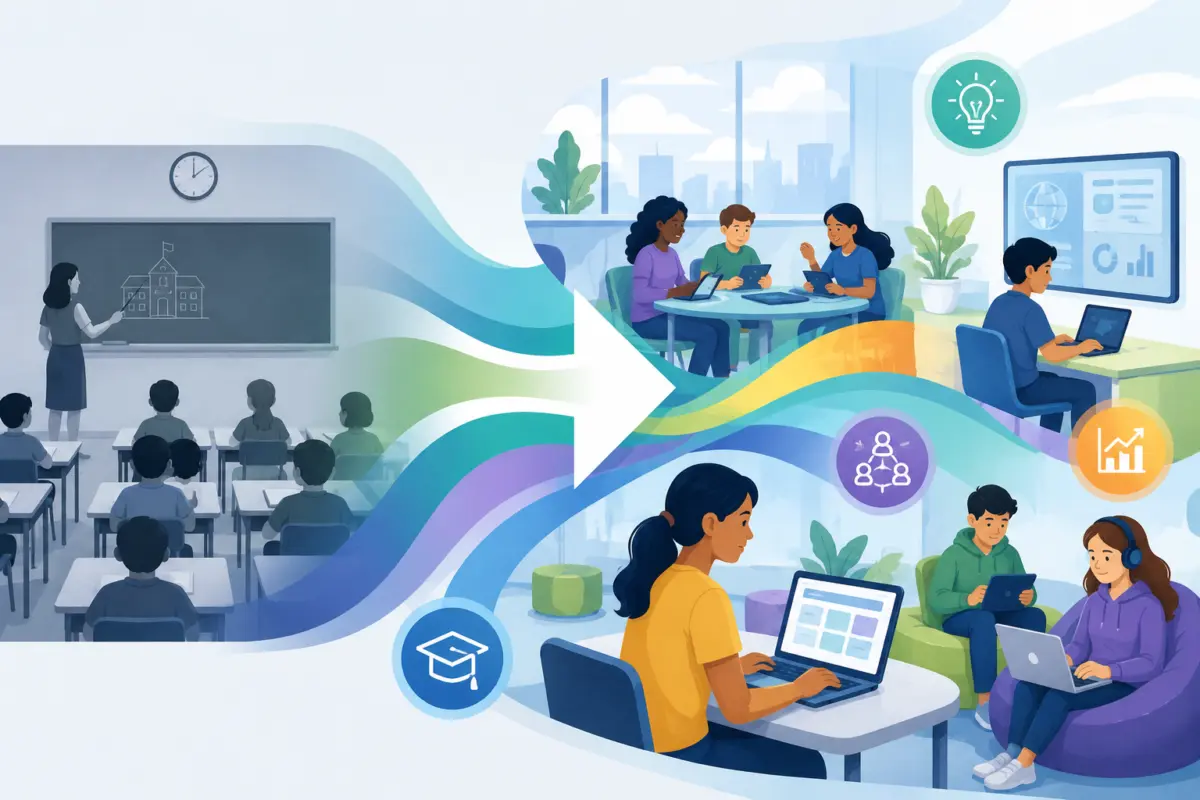
Across the United States, an unseen crisis of engagement is unfolding within the nation’s public and private K–12 classrooms. For more than a century, the American educational infrastructure has operated on a foundational premise of standardization: uniform curricula, synchronized pacing, and fixed seat-time requirements designed to ensure basic equity and operational efficiency. While this industrial-era framework successfully expanded universal literacy and access to basic education throughout the 20th century, a growing demographic of high-achieving, ambitious, and specialized learners is rapidly outgrowing its rigid parameters.
These learners range from elite student-athletes and performing artists requiring non-traditional schedules to academically gifted adolescents seeking advanced STEM and humanities coursework far beyond their grade level. Faced with instructional models calibrated to the median student, highly motivated pupils increasingly find themselves stuck in holding patterns—finishing assignments in fractions of the allocated time and waiting for peer cohorts to catch up. The structural friction manifests not merely as student boredom, but as systematic academic stagnation.
Recent empirical data underscores the scope of this migration. Federal research indicates that over 2.5 million high school students now enroll in postsecondary courses annually through dual enrollment programs, while longitudinal studies show that high-achieving students regularly fail to make a full year’s worth of academic progress in traditional environments. In response, a structural pivot is occurring. Families are increasingly bypassing traditional neighborhood schools in favor of accredited online, hybrid, and competency-based models that prioritize mastery over physical attendance. Education leaders argue that this shift represents an inflection point: the mandate is no longer simply about maintaining an standardized baseline, but about dismantling artificial ceilings to cultivate human potential.
Detailed Chronology: The Evolution of Standardized Pacing vs. Acceleration
To understand the present friction in American K–12 education, one must trace the institutional evolution of classroom structure over the past 130 years, alongside the modern rise of alternative acceleration pathways.
+-----------------------------------------------------------------------------------+
| HISTORICAL TRAJECTORY OF AMERICAN CLASSROOM DESIGN & ACCELERATION                |
+-----------------------------------------------------------------------------------+
| 1892: Committee of Ten establishes standardized Carnegie Units & age-grading.     |
| 1983: "A Nation at Risk" report shifts systemic focus toward baseline standards.  |
| 2001: No Child Left Behind (NCLB) codifies proficiency-based accountability.      |
| 2010s: Dual enrollment mandates expand nationwide; post-secondary demand spikes. |
| 2020-Present: Post-pandemic rise of competency-based, flexible hybrid learning.  |
+-----------------------------------------------------------------------------------+
The Industrial Foundation (1892–1980s)
The modern architecture of the American school system was largely codified in 1892 by the National Education Association’s "Committee of Ten." Tasked with standardizing secondary education, the committee established subject-area mandates, age-graded cohorts, and time-bound instructional blocks. By 1906, the Carnegie Foundation introduced the "Carnegie Unit"—a measure of explicit seat-time (120 hours of classroom contact per discipline) used to determine high school credit and college readiness.
This model operated as an efficient assembly line for an industrial economy. It prioritized predictability, compliance, and standardized baseline knowledge. For decades, gifted and talented (GT) programming existed primarily as pull-out enrichments or localized grade jumps, retaining the core structure of synchronized, cohort-based instruction.
The Remediation and Accountability Era (1983–2010)
The publication of A Nation at Risk in 1983, followed by the federal passage of the No Child Left Behind (NCLB) Act in 2001, reoriented federal and state educational policy. National priorities shifted decisively toward baseline proficiency, standardized testing, and closing achievement gaps at the lower end of the distribution curve.
While crucial for civil rights and baseline accountability, this policy focus inadvertently concentrated institutional resources, teacher training, and instructional time on helping struggling students reach minimum proficiency benchmarks. Consequently, differentiated instruction for high-achieving students was frequently sidelined. Accelerated learners were expected to remain within age-based physical classrooms, often acting as peer tutors or absorbing redundant content.
The Rise of Alternative Pathways (2010–Present)
By the early 2010s, structural pressures led to the widespread adoption of external safety valves. State legislatures expanded dual enrollment policies, allowing high schoolers to earn college credit concurrently. Simultaneously, advanced digital infrastructure enabled the growth of fully accredited online private and public charter schools.
The COVID-19 pandemic accelerated this shift, demonstrating to millions of families that learning need not be tied to a physical building or a fixed 8:00 AM–3:00 PM schedule. Between 2020 and 2024, alternative learning modalities—ranging from hybrid micro-schools to specialized asynchronous academies—transitioned from niche alternatives to mainstream solutions for students seeking personalized educational velocity.
Supporting Context & Metrics: Analyzing the Academic Ceiling
The impetus behind the migration away from conventional K–12 environments is rooted in performance metrics and institutional research. Data shows that traditional time-bound structures disproportionately cap the potential of students operating in the top performance quartiles.
The Growth Deficit Among High Achievers
A landmark longitudinal analysis by the Thomas B. Fordham Institute examined the trajectory of academically advanced students across multiple school districts. The research revealed a stark reality: between 30% and 50% of students who score in the top 10% on standardized assessments in early elementary school lose their high-achieving status by the time they finish middle school.
Furthermore, the study highlighted that high-achieving students often make significantly less than a calendar year’s worth of academic growth during a standard academic year. Because state accountability frameworks historically penalized schools primarily for failing to move low-performing students to basic proficiency, school leadership had little financial or structural incentive to differentiate instruction for those who had already mastered grade-level standards.
                    ACADEMIC PROGRESS RELATIVE TO POTENTIAL

Full Year Potential ---------------------------------------------> [100% Growth]
High-Achiever Actual |=========================>                   [ < 70% Growth ]
                     +----+----+----+----+----+----+----+----+----+
                     0%   10%  20%  30%  40%  50%  60%  70%  80%  90%  100%
The Surge in Dual Enrollment Data
Data published by the National Center for Education Statistics (NCES) tracks the rising demand for academic acceleration. Over 2.5 million U.S. high school students now participate in dual enrollment programs annually, taking postsecondary coursework through local community colleges and four-year universities while completing their secondary diplomas.
+-----------------------------------------------------------------------------------+
| DUAL ENROLLMENT GROWTH AND PARTICIPATION SNAPSHOT                                 |
+-----------------------------------------------------------------------------------+
| Metric                                          | Value                           |
+-------------------------------------------------+---------------------------------+
| Annual High School Dual Enrollment              | > 2,500,000 Students            |
| High Schools Offering Dual Credit               | 82% Nationwide                  |
| Average College Credits Earned Upon Graduation  | 12–30 Credit Hours              |
| Primary Driver Cited by Families                | Academic Pacing & Cost Savings  |
+-------------------------------------------------+---------------------------------+
This trend indicates that high school upperclassmen are increasingly looking beyond high school walls to find intellectual rigor. However, dual enrollment often acts as a partial solution, constrained by local university geography, scheduling conflicts with high school bell schedules, and logistical friction.
The Hidden Cost of Seat-Time Mandates
The persistent use of seat-time to measure educational progress creates structural inefficiencies:
- Time Inefficiency: Advanced students complete standard high school coursework in an estimated 30% to 50% less time than allocated, leaving hours of passive waiting or busywork daily.
- Under-Researched Equity Gaps: Low-income gifted students suffer most in traditional systems, as wealthy families can independently fund after-school tutoring, private instruction, or elite athletic academies, while low-income high achievers remain constrained by under-resourced local public frameworks.
- Behavioral Disengagement: Unchallenged high-achieving learners frequently experience chronic disengagement, anxiety, and learned helplessness, which can manifest as sudden academic drop-offs upon entering higher education.
Official Statements & Institutional Insights
Educators, institutional administrators, and learning scientists emphasize that the challenge facing American schools is structural rather than pedagogical.
Perspective from Laurel Springs School
In an analysis on modern learning environments, Allison Altvater, Dean of Middle and High School at Laurel Springs School—a pioneer in asynchronous, online education—emphasized that traditional institutional design limits today’s most driven students.
"Walk into almost any classroom in America, and you’ll see a system designed for consistency: same lesson, same pace, same expectations for every student. For decades, that model has served millions well. But today’s learners are changing, and some of the most driven among them are quietly outgrowing the structure meant to support them," stated Altvater.
Altvater highlighted that the mismatch between rigid schedules and student capabilities is not a indictment of classroom teachers, but rather an artifact of legacy design:
"This isn’t a failure of teachers or schools. It’s a reflection of how the system was built. Traditional education was designed for an earlier era, one that prioritized standardization, efficiency, and preparing students for a more predictable workforce. It made sense when access and consistency were the primary goals. But today’s world demands something different: adaptability, creativity, and highly individualized pathways."
Responding to concerns that personalized acceleration might undermine educational equity or social development, Altvater emphasized that flexibility broadens access:
"This isn’t about creating a fast track for a select few. It’s about acknowledging that one-size-fits-all no longer fits anyone particularly well. When we expand what school can look like, we create space for more students to thrive… Rigor, in this model, isn’t about moving faster for the sake of speed. It’s about meeting students where they are at the edge of their ability and helping them grow from there."
Synthesized Insights from Policy Experts
Educational policy experts echo this assessment, noting that the tension between seat-time mandates and student mastery requires a systemic shift in how state departments of education calculate school funding and progress.
+-----------------------------------------------------------------------------------+
| COMPARATIVE ANALYSIS: TRADITIONAL VS. COMPETENCY-BASED MODELS                     |
+-----------------------------------------------------------------------------------+
| Dimension               | Traditional Model         | Competency-Based Model      |
+-------------------------+---------------------------+-----------------------------+
| Progression Variable    | Time / Attendance         | Demonstrated Mastery        |
| Instructional Pacing    | Teacher / Cohort-Driven   | Student-Driven              |
| Course Catalog          | Limited to Local Faculty  | Global / Specialized Online |
| Assessment Metrics      | Letter Grades / Exams     | Rubric Mastery / Artifacts  |
| Primary Constraint      | Physical Location / Bell  | Self-Discipline / Internet  |
+-------------------------+---------------------------+-----------------------------+
Future Outlook: Redefining Rigor for the 21st Century
As traditional K–12 public and private schools navigate changing demographics, technological shifts, and evolving workforce demands, the systemic movement toward personalized acceleration is set to redefine American education over the coming decade.
1. Legislative Reforms in Funding and Seat-Time
State legislatures are beginning to decouple school district funding from physical daily attendance (Average Daily Attendance or ADA). States like New Hampshire, Utah, and Florida have led initiatives to implement "competency-based education" (CBE) frameworks. Under these policies, funding and high school course credits are awarded based on demonstrated proficiency on standardized, performance-based assessments rather than total hours spent in a classroom. Over the next decade, broader adoption of these laws will allow public school systems to offer internal, self-paced acceleration pathways without financial penalty.
2. Integration of Adaptive AI and Asynchronous Ecosystems
The rapid integration of artificial intelligence into learning platforms is changing how educational content is delivered. Generative AI and adaptive learning algorithms allow online and hybrid programs to continuously calibrate instructional difficulty to a student’s precise performance level. For high-achieving students, this means automated, real-time curriculum expansion: if a student demonstrates instant mastery of algebraic concepts, the software automatically advances them to advanced calculus or linear algebra applications, providing instant feedback without waiting for teacher intervention.
3. The Unbundling of Secondary Education
The future secondary educational model will increasingly rely on "unbundled" learning. Rather than receiving all academic, athletic, and social programming from a single brick-and-mortar neighborhood school, students will curate personalized learning portfolios:
[ Core Academics: Asynchronous Online Academy ]
                    +
[ Advanced STEM / Dual Enrollment: Local University ]
                    +
[ Extracurriculars / Athletics: Specialized Regional Hubs ]
This model enables elite performers—such as Olympic-track athletes, performing artists, and young technology entrepreneurs—to maintain rigorous academic trajectories without sacrificing their professional development.
4. Macroeconomic Imperatives
The modern economy increasingly rewards self-direction, continuous adaptability, and specialized skill mastery over passive compliance and standardized knowledge retention. By allowing driven students to move past basic proficiency barriers early, educational institutions can help build a high-skilled, globally competitive workforce.
Conclusion
As educational leadership looks toward the future, the primary goal is not to abandon public education’s historical commitments to access and community engagement, but to upgrade its operational architecture. Education is not broken, but it is fundamentally at an inflection point. By abandoning rigid seat-time assumptions, embracing scalable flexible platforms, and aligning progression with demonstrated mastery, the educational ecosystem can transform from a restrictive structure into an adaptable launchpad—raising the ceiling for all learners across the nation.

