
Executive Overview
In the realm of early childhood literacy and elementary education, the transition from simple phonetic decoding to mastering complex English orthographic patterns represents a critical developmental milestone. Among the most perplexing hurdles for emerging readers are the conditional sounds of the letters c and g. Unlike consonants with invariant representations, these two letters possess dual personalities, shifting seamlessly between "hard" plosive sounds and "soft" sibilant or affricate sounds depending on their immediate orthographic environment.
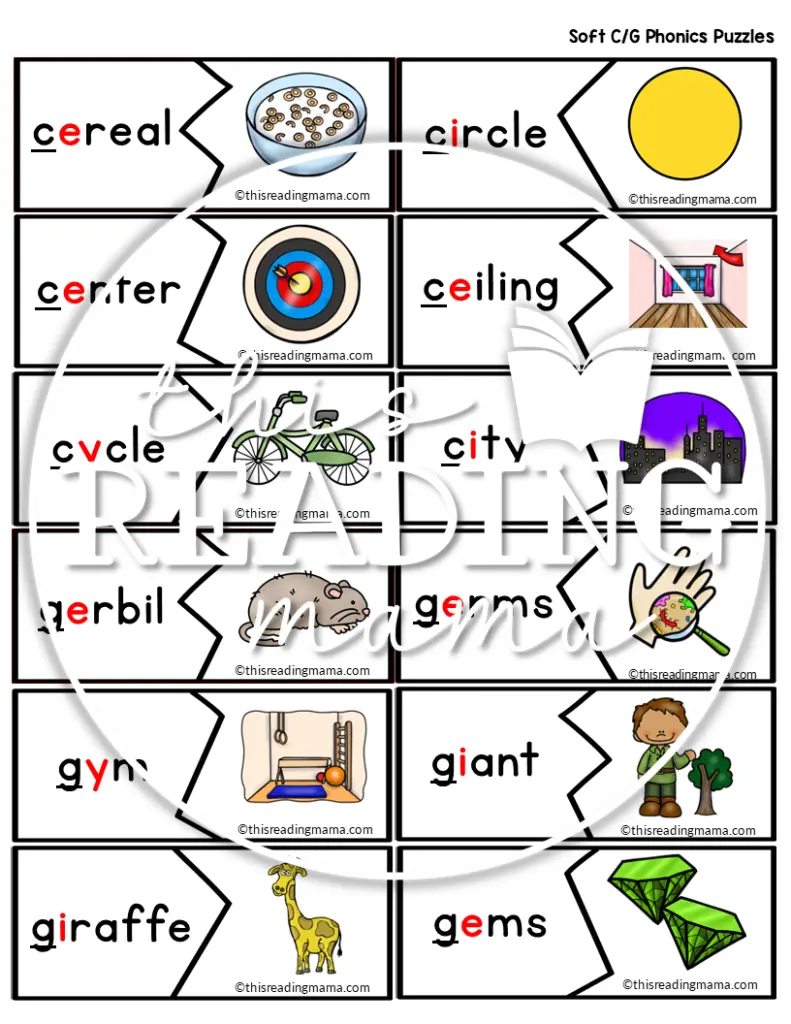
To bridge the gap between abstract phonetic rules and engaging classroom application, literacy specialist Becky from This Reading Mama has introduced a new suite of educational resources: the Soft C and G Phonics Puzzles. Designed to demystify complex spelling generalizations through tactile, play-based learning, these free downloadable puzzles aim to transform how students approach decoding. This report provides an exhaustive examination of the pedagogical theories underpinning soft c and g instruction, the structural mechanics of the newly released puzzles, and broader implications for literacy curricula in primary classrooms.
Detailed Chronology and Resource Evolution
The journey toward developing intuitive instructional materials for soft consonant rules is rooted in decades of linguistic and pedagogical research. Understanding how children acquire these concepts requires tracing the evolution of phonics instruction from rote memorization to systematic, explicit decoding frameworks.

The Historical Shift in Phonics Pedagogy
For generations, reading instruction swung between whole-language approaches and rigorous phonics drills. By the late 20th and early 21st centuries, empirical consensus—cemented by initiatives like the National Reading Panel—solidified the necessity of systematic phonics. However, teaching students that letters can change sounds based on context introduced a new instructional challenge. Educators needed tools that went beyond worksheet drills to foster genuine cognitive engagement.
The Development of This Reading Mama Frameworks
Recognizing a persistent stumbling block in her own classrooms and tutoring sessions, creator Becky developed a sequential approach to teaching hard and soft consonant variations.
- Phase 1: Identification of Hard Sounds: Initial instruction focuses on establishing baseline expectations—that c usually makes the /k/ sound (as in cat) and g makes the /g/ sound (as in goat).
- Phase 2: Introduction of the Rule (The "E, I, Y" Governor): Students are explicitly taught that the letters e, i, and y act as environmental cues that soften c to /s/ (as in city) and g to /j/ (as in giraffe).
- Phase 3: Tactical Reinforcement via Puzzles: The release of the Soft C and G Phonics Puzzles represents the latest milestone in this continuum, offering teachers and parents a hands-on mechanism to reinforce the generalization through active problem-solving rather than passive memorization.
Supporting Context & Metrics: The Mechanics of Soft C and G
To fully appreciate the utility of the new puzzles, one must examine the linguistic rules governing soft consonants and the cognitive metrics associated with phonics mastery in young learners.

Deconstructing the Phonics Generalization
In English orthography, the pronunciation of c and g is governed by positional and environmental constraints largely inherited from historical shifts influenced by Old French and Latin.
- The Soft C Rule: When the letter c is immediately followed by e, i, or y, it typically produces the voiceless alveolar sibilant /s/.
- Examples: cent, city, cycle, nice, dantist (wait, let’s stick to true soft c: dance).
- The Soft G Rule: When the letter g is immediately followed by e, i, or y, it typically produces the voiced postalveolar affricate /j/.
- Examples: gem, giraffe, gymnasium, age.
Notable Exceptions and Cognitive Challenges
No phonics rule in English is entirely absolute, and exceptions often cause cognitive friction for developing readers. As highlighted in current instructional guides, common exceptions to the soft g rule include high-frequency words such as gift and girl, where the g retains its hard /g/ sound despite being followed by an i.
Cognitive science indicates that children master invariant letter-sound correspondences quickly. However, conditional rules—where the sound depends on neighboring letters—require working memory integration. Students must scan ahead, identify the following vowel, retrieve the conditional rule, and execute the correct phonemic production. Puzzles and interactive manipulatives reduce this cognitive load by breaking the decoding process into manageable, gamified steps.

Official Statements and Pedagogical Insights
Educational leaders and curriculum developers emphasize that resources like the Soft C and G Phonics Puzzles align seamlessly with the Science of Reading framework, which champions explicit, systematic, and engaging phonics instruction.
"When children encounter irregularities or conditional rules in English orthography, telling them to ‘just sound it out’ is often insufficient," notes educational resource design literature. "They need structural scaffolding that highlights why letters change their sounds. By turning spelling generalizations into puzzle pieces, learners actively construct their understanding of phonics patterns rather than passively absorbing them."
Furthermore, creators behind these supplementary tools stress the importance of low-prep, high-impact materials for modern educators and homeschooling parents. With teachers facing immense time constraints, resources that bridge the gap between rigorous academic standards and effortless implementation are invaluable. The availability of companion materials—such as the No Prep Hard and Soft C and G Pages—creates a comprehensive ecosystem of practice options ranging from tactile puzzle assembly to independent worksheet reinforcement.
Future Outlook: The Next Wave of Literacy Tools
As educational technology and print resources continue to evolve, the demand for targeted, multi-sensory phonics tools is projected to grow. Future iterations of literacy aids are expected to focus heavily on bridging tactile print materials with digital tracking, allowing educators to monitor student mastery of complex phonics generalizations in real time.
For now, foundational tools like the Soft C and G Phonics Puzzles remain indispensable assets in the primary classroom. By equipping learners with the tools to decode complex orthographic patterns confidently, educators are laying the groundwork for advanced reading comprehension and lifelong literacy success. Teachers, reading specialists, and parents can access these free downloads, along with printing help guides and exclusive community resources via The Library membership portals, to enhance their upcoming instructional units.

