
Executive Overview
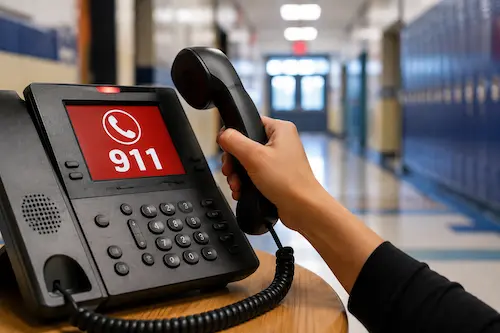
When an active security incident occurs on a school campus, every second dictates the boundary between safety and catastrophe. Yet, despite decades of capital investment in campus infrastructure, emergency response teams frequently face a fundamental handicap: operational blindness. When first responders arrive at the scene of a school threat or active shooter scenario, they step into a high-stakes environment with minimal real-time visual intelligence, forced to rely on frantic voice reports and incomplete descriptions.
The paradox of modern school security lies in the existing infrastructure. Across North America, the vast majority of public and private educational institutions are equipped with extensive video surveillance systems. However, during an active emergency, the primary coordinators of public safety—911 dispatchers and Emergency Communication Centers (ECCs)—are functionally disconnected from these camera feeds. The video streams exist, recorded continuously on local servers or closed networks, but remain locked behind administrative firewalls beyond the reach of the very personnel tasked with managing the crisis.
To resolve this critical operational disconnect, security experts, public safety agencies, and technology innovators are advocating for secure, cloud-native camera-sharing protocols. By establishing encrypted, incident-triggered connections between school video networks and ECCs, dispatchers can access live footage instantly during verified emergencies. This technical evolution transforms video surveillance from a passive post-incident forensic tool into an active tactical asset, dramatically improving response times, accuracy, and situational awareness for first responders on the ground.
Detailed Chronology: The Evolution of School Surveillance Technology
Understanding the current state of campus emergency response requires examining how school security architecture has evolved over the past three decades.
CAMPUS SURVEILLANCE & RESPONSE TIMELINE

1999–2000s: Post-Columbine Security Shift
  ├── Analog CCTV deployment accelerates nationwide
  └── Local recording (VCR/DVR); zero external network integration

2010–2011: Digital Transition & Networked IP Systems
  ├── NCES Data: 61% of U.S. public schools utilize video surveillance
  └── Video stored locally on Network Video Recorders (NVRs)

2015–2020: Cloud Integration & Early Threat Analytics
  ├── Migration to cloud-managed access control and hosted video
  └── Fragmented data silos persist between school IT and emergency dispatch

2021: Ubiquitous On-Site Surveillance
  └── NCES Data: School video surveillance adoption reaches 93%

2024–Present: Dynamic Cloud Integration & Live ECC Sharing
  ├── Event-driven camera feed sharing with 911 dispatch centers
  └── Integration of AI-driven gun detection and automated threat alerts
The Post-Columbine Blueprint (1999–2000s)
Following the tragedy at Columbine High School in 1999, educational institutions across North America undertook sweeping reviews of physical security. The initial response focused on perimeter control, physical locks, and early analog Closed-Circuit Television (CCTV) systems. These early systems operated as closed loops, recording low-resolution footage onto magnetic tapes or localized Digital Video Recorders (DVRs). Their primary purpose was post-incident investigation and deterrence rather than real-time threat mitigation.
The Digital Expansion (2010–2011)
By the turn of the decade, hardware costs decreased while IP-based network cameras gained traction. According to data from the National Center for Education Statistics (NCES), 61 percent of public schools in the United States had installed video surveillance systems by 2011. Despite this technical upgrade, the architectural design of campus security remained siloed. Systems were managed internally by school administrators or local IT staff, retaining video data within local Network Video Recorders (NVRs) behind internal firewalls.
The Modern Infrastructure Era (2021–Present)
By 2021, the NCES reported that video surveillance adoption in public schools had surged to 93 percent. Nearly every school facility possessed the hardware needed to monitor hallways, entrances, and common areas.
However, the operational reality of emergency response had not kept pace with hardware deployment. During active shooter incidents, standard operating procedures still required dispatchers to relay verbal descriptions from terrified callers to responding officers. The gap was not a lack of hardware, but an architectural barrier preventing security systems from sharing data outside the campus perimeter during active incidents.
Supporting Context & Metrics: Operational Blind Spots and Technical Realities
The disparity between hardware presence and real-time utility highlights a clear operational vulnerability in emergency management.
| Metric / Parameter | Legacy Campus Surveillance | Integrated Cloud Camera Sharing |
|---|---|---|
| School Adoption Rate (NCES, 2021) | 93% of public schools equipped | Utilizes existing 93% installed hardware base |
| Historical Adoption Rate (NCES, 2011) | 61% of public schools equipped | N/A (Legacy siloed deployment) |
| 911 Dispatcher Access | 0% real-time visibility (System locked) | Instant, event-triggered live video streaming |
| Tactical Information Source | Eyewitness reports via emergency calls | Live video streams combined with spatial mapping |
| Threat Verification Method | Delayed verbal confirmation | Direct visual assessment & AI threat analytics |
| Public / Parent Support | High demand for overall security | 96% support for real-time ECC sharing during emergencies |
The Mechanics of Operational Friction
During an active security emergency, voice-only communications encounter immediate limitations:
- Auditory Overload: 911 dispatchers must parse panicked, conflicting reports from individuals in acute distress.
- Positional Uncertainty: Telecommunicators and first responders often struggle to verify precise location data, such as specific wing numbers, floor levels, or door identifiers.
- Tactical Delays: Responding officers must approach facilities cautiously, unaware of suspect movements, weapon types, or hazard locations.
Quantitative Public Support
Public demand for integrated emergency response technologies has risen significantly. Industry surveys indicate that 96 percent of parents support sharing school camera feeds directly with Emergency Communication Centers during active shooter scenarios or critical emergencies. This strong consensus reflects a growing recognition that passive surveillance systems must be modernised to support active tactical intervention.
PARENTAL SUPPORT FOR ECC CAMERA SHARING DURING EMERGENCIES
─────────────────────────────────────────────────────────
In Favor    [█████████████████████████████████████████████] 96%
Opposed/Und [██] 4%
─────────────────────────────────────────────────────────
Convergence with AI Threat Detection
Modern camera-sharing platforms are designed to integrate with automated early-warning systems, such as artificial intelligence (AI) gun detection software. When an AI algorithm detects a firearm via a security camera, the system can automatically:
- Trigger immediate visual alerts within the school administration panel.
- Securely push the corresponding live video feed directly to the local Public Safety Answering Point (PSAP) or ECC.
- Provide dispatchers with immediate visual confirmation of the threat, exact spatial coordinates, and real-time tracking of movement.
Addressing Privacy Concerns & Policy Frameworks
While the operational advantages of camera sharing are significant, integrating educational facilities with law enforcement networks requires clear privacy protections and strict policy guidelines.
       [ NORMAL OPERATIONS ]
                 │
                 ▼
  School Cameras Record Locally / Cloud
 (NO access permitted to 911 / Law Enforcement)
                 │
                 ▼
     [ CRITICAL INCIDENT EVENT ]
  (Panic Button / AI Threat / 911 Call)
                 │
                 ▼
    [ SECURE INTEGRATION GATEWAY ]
 Instant, Timed Access Granted to ECC Dispatchers
                 │
                 ▼
    [ INCIDENT RESOLUTION ]
 Access Automatically Revoked; Audit Log Generated
Differentiating Surveillance from Emergency Access
A primary obstacle to widespread implementation is the misconception that camera-sharing technology enables continuous, unmonitored surveillance of students and staff. Technical and policy frameworks are specifically designed to prevent this:
- No Continuous Monitoring: Systems do not provide public safety agencies with ongoing live feeds during routine school hours.
- Event-Driven Authorization: Access to video feeds is strictly restricted to active, verified emergencies—such as an activated panic button, an automated threat detection event, or a confirmed 911 call.
- Defined Access Lifespans: Permissions are time-bound. Once the emergency is cleared by incident command, live streams automatically disconnect.
Technical Safeguards and Governance
To maintain compliance with privacy standards, such as the Family Educational Rights and Privacy Act (FERPA), school districts and emergency services deploy robust technical safeguards:
- Role-Based Access Control (RBAC): Access is limited exclusively to authorized telecommunicators and incident commanders.
- Cryptographic Auditing: Every instance of video access generates an immutable audit log detailing who viewed the feed, the exact timestamps of access, and the trigger event that authorized entry.
- Data Isolation: Feeds are transmitted via encrypted pipelines without exposing internal school administrative networks or unrelated student records.
Official Statements & Industry Perspectives
Industry leaders emphasize that overcoming technical fragmentation is essential for improving public safety infrastructure.
Dean Drako, Chairman and CEO of Brivo—a global developer of cloud-native physical security solutions—underlines that the obstacle is structural rather than technological:
"The gap isn’t about technology; it’s about access. The cameras are there and the footage exists, but it stays locked inside school systems, out of reach for the people who need it most in real time."
Drako, an industry veteran who previously founded Barracuda Networks and launched cloud surveillance platform Eagle Eye Networks, notes that unified cloud platforms eliminate historical information bottlenecks:
"With real-time visibility, dispatchers can relay specific, actionable information to first responders, such as where a suspect is located, who’s in danger, which areas are unsecured, and whether a weapon is visible. That kind of critical visual intelligence shapes decisions before anyone arrives on scene."
He emphasizes that maintaining clear boundaries between daily school operations and active crisis management is critical to privacy governance:
"These systems are not engaged in continuous monitoring or expanding surveillance… Access is limited to the duration of an actual emergency, ensuring privacy is maintained during normal situations. The goal isn’t more oversight or gathering data on students; it’s to ensure better information in critical moments."
Future Outlook: Smart Campuses, AI Interoperability, and Next-Gen Response
The integration of campus security cameras with emergency command structures represents a key step toward comprehensive smart city safety architecture. As technology evolves, several emerging developments will shape campus physical security:
1. Unified Cloud Security Suites
Educational institutions are increasingly moving away from disconnected physical security products. Modern implementations unify access control, video surveillance, visitor management, and intrusion alarms into single, cloud-native platforms. This integration enables synchronized automated responses—such as locking specific perimeter doors while simultaneously streaming video from adjacent corridors to emergency dispatchers.
2. Multi-Sensor Data Fusion
Future emergency management platforms will combine video feeds with additional data streams, including acoustic gunshot detection, spatial mapping, and electronic access logs. By combining these data points, AI systems can generate dynamic floor plans that trace threat movements and identify safe evacuation routes for staff and students in real time.
3. Legislative Alignment and Funding Initiatives
State and federal lawmakers across the United States are introducing legislation to standardize emergency response infrastructure in schools. Initiatives similar to Alyssa’s Law—which mandates panic alarms in public schools—are expanding to include requirements for video interoperability with local 911 centers. Corresponding state grants are increasingly targeting cloud migration and public safety connectivity.
Conclusion
The widespread adoption of physical security cameras in schools established an essential foundation for campus safety. However, passive recording systems offer limited utility during an active crisis. By securely bridging the communication gap between school video networks and emergency dispatch centers, educational leaders and public safety agencies can provide first responders with the real-time visual intelligence needed to act decisively and protect lives.

