In an era characterized by hyper-connectivity, digital saturation, and relentless external stimuli, children and adolescents face unprecedented challenges to their cognitive focus and emotional equilibrium. Parents, educators, and mental health professionals increasingly report difficulties among youth regarding sustained attention, impulse control, and emotional regulation. While these challenges are frequently addressed through behavioral management or academic intervention, a powerful, evidence-based modality is gaining momentum in developmental psychology and education: mindfulness.
Far beyond a contemporary buzzword or a passive relaxation technique, mindfulness—the practice of directing one’s attention inward to focus intentionally on the present moment—serves as a robust catalyst for sharpening executive functioning skills. These high-level, brain-based processes govern our ability to plan, prioritize, regulate impulses, manage time, and navigate complex challenges.
When integrated thoughtfully into daily routines, mindfulness activates the prefrontal cortex—the brain’s "thinking center"—offering children and teens an internal compass. By examining the direct correlation between mindful awareness and executive capabilities, educators and caregivers can unlock transformative strategies to support youth development, turning simple breathing exercises and grounding techniques into lifelong cognitive assets.
Detailed Chronology and Evolution of Mindfulness in Education
The integration of contemplative practices into secular Western environments did not happen overnight. To understand how mindfulness became recognized as a vital tool for youth cognitive development, it is helpful to trace its evolution from ancient traditions to modern neuroscience and classrooms.
Phase 1: The Clinical Foundation (Late 20th Century)
In the late 1970s and 1980s, pioneers like Dr. Jon Kabat-Zinn introduced Mindfulness-Based Stress Reduction (MBSR) to clinical settings, stripping meditative traditions of their religious contexts to focus strictly on physiological and psychological healing. Studies during this period primarily tracked stress reduction, chronic pain management, and anxiety mitigation in adult patients.
Phase 2: The Neuroscientific Breakthrough (Early 2000s)
As neuroimaging technologies such as fMRI advanced into the 21st century, researchers began looking inside the brain during meditative states. Neuroscientists discovered that consistent mindfulness practices physically alter brain structures—increasing gray matter density in the hippocampus (responsible for learning and memory) and decreasing reactivity in the amygdala (the brain’s fear and stress center). This biological evidence shifted the perception of mindfulness from a soft lifestyle choice to a hard science capable of restructuring neural pathways.
Phase 3: Translation to Youth and Academic Settings (2010s–Present)
Recognizing that neural plasticity is highest during childhood and adolescence, researchers and educators began adapting mindfulness curricula for schools. Programs such as Inner Explorer, Mindful Schools, and CASEL-aligned Social-Emotional Learning (SEL) frameworks demonstrated that children could learn self-regulation early. Over the past decade, empirical studies have linked these school-based mindfulness programs directly to enhancements in executive functioning—proving that teaching a child to notice their breath is fundamentally teaching them how to organize their thoughts, manage time, and persist through academic adversity.
Supporting Context & Metrics: The Six Pillars of Executive Functioning
Executive functioning is not a single skill, but a complex orchestra of cognitive processes. Practicing mindfulness impacts several distinct domains of executive functioning, each playing a critical role in a young person’s daily success.
+-------------------------------------------------------------------------+
|                  THE EXECUTIVE FUNCTIONING FRAMEWORK                    |
+-------------------------+-----------------------------------------------+
| Domain                  | Cognitive Function & Mindfulness Impact       |
+-------------------------+-----------------------------------------------+
| Focus & Attention       | Trains the mind to return to the "right now." |
| Self-Control            | Creates a pause between impulse and action.   |
| Emotional Regulation    | Manages feelings without being overwhelmed.   |
| Working Memory          | Clears mental clutter to hold new data.       |
| Flexible Thinking       | Encourages non-judgmental perspective-taking. |
| Perseverance            | Builds resilience through sustained practice. |
+-------------------------+-----------------------------------------------+
1. Focus and Attention
The Definition: Attention is the capacity to concentrate on a specific individual, task, or concept over a designated timeframe. Youth rely on attention for everything from active listening in classroom discussions to maintaining focus through multi-step math assignments.
The Mindfulness Connection: Mindfulness exercises directly condition attentional control. When individuals focus entirely on their respiration, they actively train their brains to anchor in the present. When the mind inevitably wanders—as it naturally does—the act of gently steering attention back to the breath acts as "reps" at a cognitive gym, progressively building sustained attention muscles.
2. Self-Control
The Definition: Self-control is the neurological brake system that enables individuals to halt, assess, and deliberate before executing a decision, inhibiting immediate, reactive impulses.
The Mindfulness Connection: Mindfulness introduces a microscopic pause between an internal trigger and an external reaction. For example, an adolescent passing a celebratory hallway display might experience an immediate urge to disrupt it. Through ingrained mindfulness practices, that same student can recognize the impulse, execute a grounding breath, and let the urge dissipate. Over time, this transforms impulsive liabilities into calculated, positive choices.
3. Emotional Regulation
The Definition: Emotional regulation involves identifying, interpreting, and managing daily affective states. It forms the foundational baseline determining how youth feel, think, and interact throughout their day.
The Mindfulness Connection: Mindfulness cultivates meta-awareness—the ability to observe emotions as transient weather patterns rather than permanent floods. When a teenager is excluded from a collaborative group project, the instinctive reaction might be explosive anger or withdrawal. Deep, mindful breathing acts as a physiological reset button, shifting the nervous system from fight-or-flight back to a calm state where constructive problem-solving can occur.
4. Working Memory
The Definition: Working memory is our mental workspace: the capacity to retain, manipulate, and update complex information over short intervals. It is heavily utilized when following sequential instructions or solving multi-layered problems.
The Mindfulness Connection: Chronic stress and overstimulation create cognitive "clutter," consuming valuable working memory capacity. Mindfulness acts as a mental defragmentation tool. By clearing out extraneous, anxious thoughts, mindfulness provides students with a clean slate, allowing them to hold and manipulate essential information more efficiently.
5. Flexible Thinking
The Definition: Cognitive flexibility represents the capacity to switch perspectives, adapt to shifting parameters, and embrace alternative viewpoints when initial plans fail.
The Mindfulness Connection: Mindfulness fosters an attitude of non-judgmental acceptance toward experiences, even unfavorable ones. When a young adult receives critical editorial feedback on an essay, flexible thinking—grounded in acceptance—prevents them from internalizing the critique as a personal failure, instead reframing it as a vehicle for growth.
6. Perseverance
The Definition: Perseverance, closely tied to grit, is the determination to persist with a challenging task despite obstacles or the temptation to quit.
The Mindfulness Connection: Sustaining a mindfulness practice can be inherently challenging; the brain continually attempts to escape stillness. By consciously committing to stay present through the discomfort of a wandering mind, individuals practice micro-doses of perseverance. This resilience seamlessly transfers to complex academic assignments and personal goals.
Practical Strategies for Implementing Mindfulness with Youth
Successfully introducing mindfulness to children and teens requires meeting them where they are. Educators and parents should first demystify the practice, framing mindfulness not as a chore, but as a performance-enhancing tool. Explain that mindfulness is utilized by athletes before high-stakes games and public speakers to steady their nerves before stepping onto a stage.
A variety of accessible, evidence-based activities can be seamlessly integrated into daily routines:
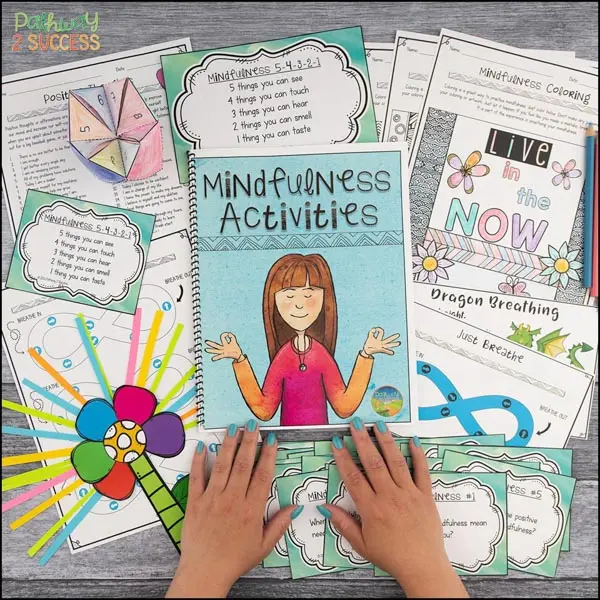
Mindful Breathing: Rooted in fundamental breathing exercises, techniques like "Cool Off the Pizza" or "Shape Breathing" teach youth to anchor themselves instantly. These serve as exceptional brain breaks between rigorous academic modules.
Mindful Coloring: Engaging in structured coloring without the pressure of artistic perfection allows children to immerse themselves completely in tactile, present-moment creation.
Yoga and Gentle Stretching: Combining intentional movement with synchronized breathing helps youth connect somatic awareness with cognitive calm.
Mindful Journal Writing: Starting the day with reflective prompts or open-ended writing gives students a secure outlet to process internal thoughts and regulate emotions.
Outdoor Mindfulness: Leveraging nature walks, cloud-watching, or wildlife observation provides boundless, organic focal points for grounding attention.
Mindful Affirmations: Repeating positive, anchoring phrases during slow, measured breathing helps restructure self-talk and sets an intentional tone for the morning.
Mindful Observance: Focusing intensely on a mundane physical object—such as a pen or a water bottle—trains sensory awareness and strengthens observational discipline.
Official Perspectives and Expert Insights
Developmental psychologists and educational researchers emphasize that executive functioning skills are not entirely fixed at birth; rather, they develop gradually well into young adulthood, heavily influenced by environmental scaffolding.
"Executive functions are the air traffic control system of the brain," notes developmental literature from leading child advocacy institutions. "When we introduce structured mindfulness into schools and homes, we are essentially upgrading the control tower. We are giving children the explicit tools they need to manage the heavy air traffic of modern stimuli, ensuring that attention, working memory, and self-control operate with precision and safety."
Furthermore, educators utilizing social-emotional learning frameworks report that mindfulness acts as a great equalizer. Classrooms that incorporate regular mindful pauses observe reductions in disciplinary infractions and notable improvements in collaborative problem-solving. By teaching children how to pause, breathe, and reflect, adults are not merely managing classroom behavior—they are rewiring neurological pathways for lifelong resilience.
Future Outlook
As the educational landscape continues to evolve, the integration of mindfulness and executive functioning training is shifting from an experimental enrichment activity to a foundational pillar of holistic child development. Future initiatives aim to embed cognitive-mindfulness metrics directly into school curricula, backed by longitudinal studies tracking neuroplasticity and academic achievement across diverse demographics.
The imperative moving forward is clear: as technological advancements continue to accelerate and external distractions multiply, the human capacity for deep focus, emotional regulation, and flexible thinking will only grow more valuable. By equipping the next generation with the simple, timeless tools of mindfulness, we do more than help them survive a busy day—we structurally empower them to master their own minds, navigate life’s inevitable challenges, and realize their full human potential.