
Executive Overview
In the landscape of early childhood education, bridging the gap between foundational phonological awareness and engaging classroom activities remains a primary objective for Pre-K and kindergarten educators. As schools increasingly adopt methodologies aligned with the Science of Reading, the demand for high-yield, developmentally appropriate literacy centers has surged. Addressing this critical educational need, early childhood resource platforms have rolled out a comprehensive suite of tools designed to cultivate auditory discrimination and phonological processing through seasonal themes.
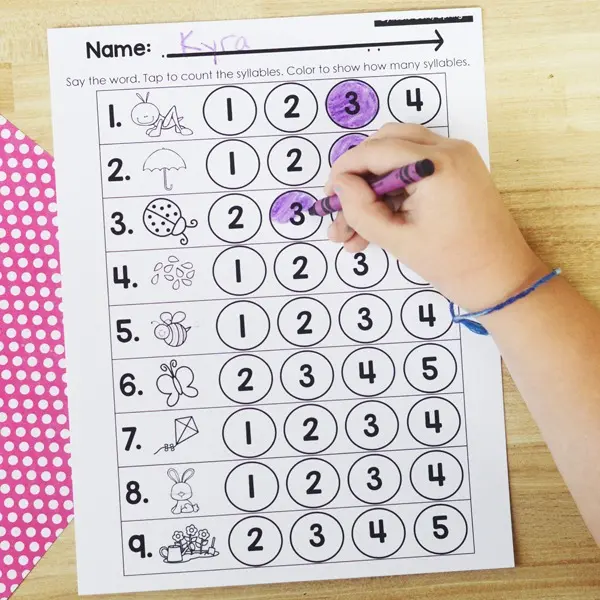
At the forefront of this initiative is the newly released Spring Theme Syllable Sort and its expanded counterpart, the Four Seasons Syllable Sort. These pedagogical frameworks are meticulously engineered to help young learners isolate, segment, and count syllables using tactile and auditory strategies. By moving away from premature orthographic decoding and focusing intensely on the sounds of spoken language, these printable activities provide an essential stepping stone toward fluent reading and spelling. This report explores the pedagogical foundations of these tools, their structural implementation in modern classrooms, and their broader implications for early childhood literacy curricula.

Detailed Chronology: The Evolution of Phonological Awareness in Early Childhood Curricula
To understand the significance of targeted syllable sorting activities, one must examine the evolution of early reading instruction over the past several decades.
The Shift Toward Phonological Processing
- Early Foundations (Late 20th Century): For generations, kindergarten and preschool classrooms relied heavily on whole-word recognition and basic memorization techniques. While children learned the alphabet, the connection between spoken phonemes, syllables, and written text was often treated as a secondary concern.
- The Emergence of the Science of Reading (2000s–2010s): Comprehensive longitudinal research synthesized by organizations like the National Early Literacy Panel (NELP) established that phonological awareness—the ability to recognize and manipulate the spoken parts of sentences and words—is a primary predictor of later reading success. Educators began pivoting away from rote memorization toward systematic, explicit instruction in phonics and phonological awareness.
- The Modern Integration (Present Day): Today, early childhood frameworks emphasize multi-sensory approaches. Activities that incorporate physical movement (such as clapping or tapping) alongside auditory processing have become standard best practices in Pre-K and kindergarten settings. The introduction of thematic, seasonal sorting tasks represents the latest evolution in making these rigorous cognitive exercises accessible and enjoyable for young children.
Development and Deployment of Seasonal Syllable Sorts
- Concept Inception: Recognizing that young children respond best to contextualized learning, curriculum developers sought to tie fundamental literacy skills to familiar seasonal concepts (spring blossoms, summer sun, autumn leaves, and winter snow).
- Pilot Implementation: Early iterations of the syllable sorting cards were tested in select preschool literacy centers, focusing strictly on picture-based prompts rather than written words. This ensured that children were evaluating pure auditory units rather than visual spelling patterns.
- Public Release and Expansion: Building on the success of the initial spring-themed resources, developers expanded the concept into a comprehensive 42-page, four-seasons resource pack. This expansion provided educators with a year-round curriculum supplement available through specialized teaching platforms and digital marketplaces like Teachers Pay Teachers.
Supporting Context & Metrics: The Science Behind Syllable Segmentation
Phonological awareness operates on a continuum of increasing complexity, typically progressing from word-level awareness to syllable awareness, onset-rime manipulation, and finally, individual phoneme segmentation. Syllable segmentation sits securely in the middle tier of this developmental hierarchy, serving as a critical bridge between macro-level word awareness and micro-level phonics.

Key Developmental Metrics in Early Literacy
- Ages 3 to 4: Children typically develop the capacity to recognize rhyme and begin blending compound words. Simple syllable clapping games at this stage help build initial auditory awareness.
- Ages 4 to 5 (Pre-K): Children advance to segmenting two- and three-syllable words. Research indicates that structured activities involving physical prompts (clapping, tapping, or using manipulatives) improve syllable-counting accuracy by up to 40% compared to auditory-only instruction.
- Ages 5 to 6 (Kindergarten): Students master syllable isolation and begin connecting segmented oral structures to printed graphemes. Systematic sorting activities reinforce this transition by requiring children to categorize vocabulary based on structural syllable counts.
Structural Components of the Spring and Four Seasons Packs
The newly introduced instructional materials are designed to eliminate preparation friction for educators while maximizing student engagement. The foundational spring packet and the comprehensive four-seasons edition include:
- Syllable Counting Cards: Visual prompt cards featuring vibrant, seasonal vocabulary designed to stimulate discussion and word recognition.
- Kinesthetic Integration: Explicit instructions for teachers on incorporating physical movement (clapping, stomping, or tapping) to represent syllable breaks.
- Independent Practice Worksheets: Black-and-white response sheets that allow students to demonstrate comprehension individually following center-based group work.
- Comprehensive Answer Keys: Designed for quick formative assessment, allowing educators or classroom aides to verify student sorting accuracy efficiently.
Official Statements and Expert Perspectives
Educational specialists and early childhood curriculum designers have emphasized the necessity of play-based, auditory-first approaches in modern classrooms.

"When we ask children to look at a written word before they can successfully hear and isolate its constituent parts, we run the risk of overwhelming their cognitive working memory," notes an early literacy curriculum specialist. "Tools like the Spring Syllable Sort strip away the early distraction of spelling, allowing young learners to focus entirely on the rhythm and sound structure of language. By clapping, tapping, and sorting spring vocabulary, children build the neural pathways necessary for future reading fluency."
Furthermore, experts highlight the importance of vocabulary introduction prior to independent center work.

"An activity is only as effective as a child’s familiarity with the underlying concepts," states a veteran kindergarten educator. "Before students drop picture cards into one-, two-, or three-syllable bins, teachers must explicitly introduce the vocabulary—whether it’s ‘tulip,’ ‘butterfly,’ or ‘raincoat.’ This ensures that reading comprehension and phonological awareness develop concurrently."
Future Outlook: The Direction of Early Childhood Literacy Centers
As educational standards continue to evolve, the integration of targeted, theme-based phonological awareness activities is expected to expand. Several key trends are shaping the future of early literacy center design:

1. Multi-Sensory and Kinesthetic Learning Integration
Future literacy resources will likely lean even further into physical movement. Educators are finding that tactile engagement—such as moving tokens for each syllable heard or physically jumping across floor mats marked with syllable numbers—drastically improves retention among active learners.
2. Seamless Blend of Digital and Print Resources
While physical manipulatives and cut-and-paste worksheets remain vital for developing fine motor skills and tactile engagement, digital adaptations of sorting games are increasingly finding a home in blended classrooms. Platforms offering printable packs like the Four Seasons Syllable Sort are exploring companion digital formats to support hybrid learning models.

3. Comprehensive Seasonal Curricula
The success of seasonal literacy modules points toward a broader industry shift: moving away from isolated worksheet packets toward holistic, thematic curriculum bundles. By anchoring literacy instruction to the changing seasons, educators can maintain high student engagement throughout the academic year while systematically addressing core reading standards.
Conclusion
The release of the Spring Theme and Four Seasons Syllable Sorts offers a timely, evidence-based solution for educators striving to meet rigorous early literacy benchmarks. By combining the principles of the Science of Reading with engaging, seasonally relevant imagery and kinesthetic prompts, these resources empower Pre-K and kindergarten students to master syllable segmentation with confidence. As schools continue to prioritize foundational phonological processing, such innovative, low-prep tools will remain indispensable assets in the modern classroom.

