
EXECUTIVE OVERVIEW
In the landscape of early childhood education, the transition from spoken language to structured literacy represents one of the most critical milestones in a child’s cognitive development. As educational institutions increasingly align with the evidence-backed principles of the Science of Reading, the focus on foundational phonological awareness has taken center stage. A groundbreaking pedagogical tool—the Spring Syllable Sort, alongside its comprehensive counterpart, the Four Seasons Syllable Sort—is redefining how preschool, pre-K, and kindergarten educators approach foundational reading skills.
Designed to foster auditory discrimination, word segmentation, and seasonal vocabulary acquisition, these multi-sensory printables provide a structured yet engaging mechanism for young learners to isolate word parts. By combining tactile learning methods—such as clapping and tapping—with vibrant visual cues, the curriculum bridges the gap between abstract phonological concepts and concrete cognitive mapping. This report provides an exhaustive examination of the mechanics, educational philosophy, structural components, and long-term implications of implementing seasonal syllable-sorting frameworks within modern early learning environments.

The Science of Reading and Phonological Foundations
To understand the profound impact of the Spring Syllable Sort activity, one must first examine the broader educational shifts currently sweeping through early childhood classrooms. Over the past decade, cognitive scientists, linguists, and reading specialists have coalesced around the "Science of Reading"—a vast body of interdisciplinary research that details how the human brain learns to read. A core tenet of this research is that reading does not occur naturally; it must be explicitly taught.
Before children can map sounds to letters (phonics), they must first master phonological awareness—the broad ability to recognize, think about, and manipulate the spoken parts of sentences and words. Phonological awareness encompasses rhyming, alliteration, sentence segmentation, onset-rime manipulation, and, crucially, syllable segmentation.
Syllables serve as the natural rhythmic beats of spoken language. For young children, hearing and counting these beats is significantly easier than isolating individual phonemes (the smallest units of sound). Consequently, syllable work acts as a vital stepping stone. It trains the auditory cortex to tune into the internal structure of words.

The Spring Syllable Sort activity leverages this developmental readiness. By engaging children in a multi-sensory exercise where they physically clap or tap out the beats of spring-themed vocabulary words, educators tap into kinesthetic learning pathways. This active engagement reinforces neural connections, making the abstract concept of word parts tangible and accessible to pre-K and kindergarten minds.
Anatomy of the Activity: Design and Pedagogical Mechanics
The design of the Spring Syllable Sort is rooted in intentional instructional scaffolding. Rather than throwing children into the deep end of reading text-based definitions, the activity prioritizes spoken sounds and rich picture clues. This ensures that children who are still pre-readers can fully participate, building confidence alongside core literacy skills.
Key Structural Components of the Free Printable
- Syllable Counting Cards: Illustrated cards featuring iconic spring motifs that prompt children to physically count the breaks in words.
- Large Colorful Word Cards: Designed for group instruction, pocket charts, or guided reading tables, allowing teachers to model sorting strategies explicitly.
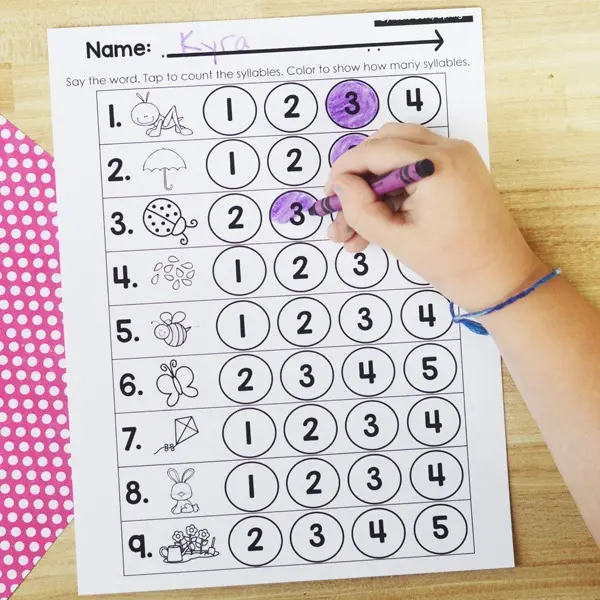
- Black and White Response Worksheets: Optional independent practice sheets that enable students to solidify their understanding and provide educators with immediate formative assessment data.
- Comprehensive Answer Keys: Ensuring accuracy and ease of use for classroom aides, volunteers, or parents facilitating take-home literacy practice.
Step-by-Step Implementation Strategy
- Vocabulary Introduction: Experts emphasize that children cannot accurately sort words by syllables if they do not know what the picture represents. Teachers are advised to introduce and discuss the vocabulary words prior to the independent activity.
- Kinesthetic Segmenting: Students say the target word aloud while clapping hands, tapping fingers, or marching in place to match the rhythmic beats.
- Sorting and Categorization: Learners place the picture cards into designated categories (e.g., one-syllable, two-syllable, or three-syllable groups).
- Independent Application: Once guided practice is complete, students complete the accompanying worksheet to demonstrate mastery.
Expanding the Framework: The Four Seasons Syllable Sort Ecosystem
While spring provides a vibrant, renewing backdrop for literacy engagement, early childhood educators require year-round tools that maintain pedagogical consistency. Recognizing this need, developers have expanded the foundational spring model into a comprehensive 42-page "Four Seasons Syllable Sorts" ecosystem.

This expanded curriculum scales the successful mechanics of the spring activity across the entire annual cycle, encompassing winter, spring, summer, and autumn themes. By maintaining a consistent operational framework while rotating seasonal vocabulary, the program minimizes cognitive load regarding how to do the task, allowing children to focus entirely on the linguistic content.
Comprehensive Seasonal Coverage
- Winter: Vocabulary focusing on cold weather, garments, and seasonal phenomena.
- Spring: Blooming flora, garden animals, and vernal weather patterns.
- Summer: Outdoor recreation, warm-weather nature, and environmental elements.
- Autumn: Harvest motifs, changing foliage, and seasonal transitions.
This cyclical approach ensures that phonological awareness remains fresh, dynamic, and contextually relevant throughout the school year. Furthermore, the inclusion of clip cards and interactive sorting mats provides versatile options for literacy centers, small-group interventions, and independent work stations.
Supporting Context, Metrics, and Classroom Integration
Integrating phonological awareness activities into daily preschool routines yields measurable dividends in later reading achievement. Longitudinal studies in early literacy demonstrate that children who enter kindergarten with strong phonological awareness skills are significantly better positioned to master decoding, spelling, and reading comprehension by the end of first grade.

Versatile Integration Scenarios
The adaptability of the Spring Syllable Sort makes it an invaluable asset across diverse educational settings:
- Literacy Centers: Serving as an independent or semi-guided station where students can reinforce skills learned during direct instruction.
- Small-Group Interventions: Providing targeted support for children who require additional scaffolding in auditory discrimination and word segmentation.
- Take-Home Literacy Practice: Extending learning beyond the classroom walls, empowering parents to engage in playful, research-backed literacy activities with their children.
- Seasonal Thematic Units: Seamlessly blending science, nature study, and language arts by utilizing thematic vocabulary (e.g., flower, raincloud, caterpillar).
By utilizing picture-based prompts rather than text-heavy worksheets, the activity successfully engages diverse learners, including English Language Learners (ELL) and students with varying developmental trajectories. Visual cues transcend language barriers, enabling all students to access the phonological concepts being taught.
Future Outlook: The Evolution of Play-Based Literacy Instruction
As educational standards continue to evolve in response to empirical research, the demand for high-quality, engaging, and developmentally appropriate materials will only intensify. The shift away from rote memorization and drill-and-kill worksheets toward interactive, play-based learning models represents a permanent paradigm shift in early childhood education.

The success of tools like the Spring Syllable Sort and the Four Seasons Syllable Sorts signals a bright future for literacy instruction. By respecting the cognitive realities of young learners—who require movement, visual stimulation, and thematic context to anchor abstract concepts—these resources prove that rigorous academic standards and joyful play are not mutually exclusive.
Looking ahead, educators can anticipate continued innovation in how foundational skills are packaged and delivered. The integration of digital accessibility with tactile printables, combined with cross-curricular themes that link literacy to science and the natural world, will undoubtedly remain at the forefront of early childhood curriculum development. For now, simple tools like a spring-themed syllable sorting card deck stand as powerful catalysts, sparking a lifelong love of reading one clapped-out syllable at a time.

