
Executive Overview
In the landscape of modern early childhood education, bridging the gap between theoretical pedagogical research and engaging classroom practice remains a formidable challenge. As educators and curriculum developers increasingly embrace the "Science of Reading"—a comprehensive body of scientifically based research about reading and issues related to reading and writing—the demand for targeted phonological awareness tools has reached an all-time high.
Enter the Spring Syllable Sort and its broader counterpart, the Four Seasons Syllable Sort curriculum series. Developed to address foundational reading skills in preschool, pre-K, and kindergarten classrooms, these interactive resources transform abstract phonological concepts into tangible, hands-on learning experiences. By merging seasonal vocabulary with multi-sensory segmentation techniques—such as clapping and tapping—these printables offer educators a structured yet playful pathway to boost early literacy.
This comprehensive report examines the pedagogical underpinnings of the syllable sort activities, details their classroom implementation, explores the broader 42-page seasonal curriculum framework, and evaluates their future outlook in modern early learning environments.

Detailed Chronology & Pedagogical Evolution
The Shift Toward Phonological Awareness
For decades, early reading instruction often relied heavily on whole-word memorization or unstructured exposure to text. However, as cognitive scientists and educational researchers mapped out how the human brain learns to read, the critical role of phonological awareness—the ability to recognize and manipulate the spoken parts of sentences and words—came to the forefront.
Syllables represent one of the most accessible entry points into phonological awareness for young children. Unlike individual phonemes (which can be abstract and blending-resistant), syllables possess a natural rhythm and beat that align organically with a child’s developing auditory processing system.
Conceptualization of the Spring Syllable Sort
Recognizing the need for materials that resonate with young learners, early childhood education specialists designed the Spring Syllable Sort. The framework was built on a simple yet effective chronological routine for classroom literacy centers:

- Vocabulary Introduction: Educators explicitly introduce seasonal vocabulary using picture cards before independent practice.
- Auditory Segmenting: Students say the word aloud, utilizing kinesthetic movements like clapping, stomping, or tapping to physically feel the word parts.
- Quantitative Counting: Children count the distinct bursts of sound (syllables) identified during segmenting.
- Categorization & Sorting: Picture cards are sorted into designated bins or mats based on their syllable counts.
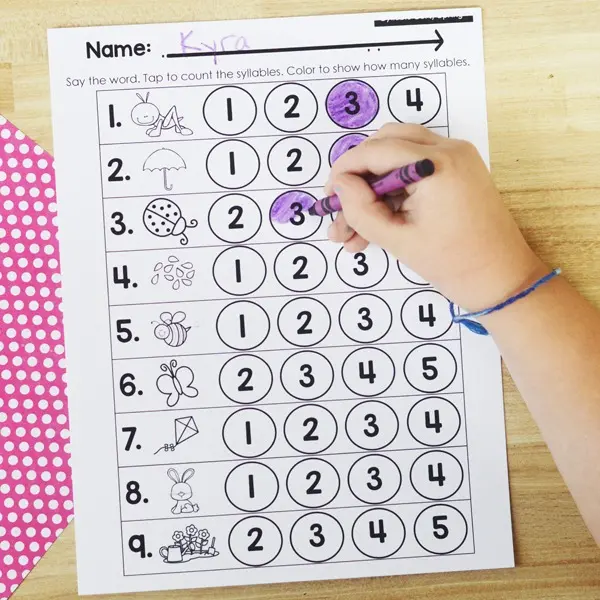
- Independent Reinforcement: Students complete an optional black-and-white response worksheet to solidify their understanding.
Expansion into the Four Seasons Curriculum
Building upon the success of the spring-themed pilot materials, developers expanded the methodology into a comprehensive, year-round framework: the Four Seasons Syllable Sorts. Spanning a robust 42-page pack, this curriculum extension scales the core principles across autumn, winter, spring, and summer, ensuring that phonological awareness activities remain fresh, seasonally relevant, and tightly integrated with thematic units throughout the academic year.
Supporting Context & Metrics
Aligning with the Science of Reading
The Science of Reading emphasizes explicit, systematic instruction in foundational skills. Syllable segmentation is not merely a fun game; it is a cognitive stepping stone toward decoding multi-syllabic words in later reading development.
- Auditory Processing vs. Visual Decoding: By intentionally focusing on sounds and picture clues rather than presenting written words prematurely, the Spring Syllable Sort isolates phonological awareness. This prevents cognitive overload, allowing children to master the auditory structure of language before burdening their working memory with grapheme-phoneme (letter-sound) correspondence.
- Multi-Sensory Engagement: Kinesthetic learning styles are heavily supported through physical clapping and tapping. Research indicates that incorporating gross and fine motor movements into cognitive tasks enhances memory retention and student engagement, particularly in early childhood demographics (ages 3–6).
Curriculum Component Breakdown
The Spring Syllable Sort and its extended Four Seasons counterpart are meticulously packaged to provide maximum utility for educators operating on limited preparation time. The core freebie and expanded packs include:

- Syllable Counting Cards & Clip Cards: Durable, tactile components that invite children to use clothespins, counters, or finger placements to indicate syllable counts.
- Large Colorful Word & Picture Cards: High-contrast, vibrant visual aids designed to capture the attention of pre-K and kindergarten learners while introducing rich thematic vocabulary.
- Response Worksheets: Scalable black-and-white printables suitable for individual formative assessment, homework, or center accountability.
- Comprehensive Answer Keys: Streamlined reference guides that allow teachers or classroom aides to verify student work quickly and efficiently.
Official Statements and Educational Insights
While commercial product rollouts in education often prioritize flash over substance, pedagogical experts and classroom practitioners have praised structured sorting activities for their adherence to evidence-based practices.
"Phonological awareness is the anchor of early literacy. When children learn to segment words into syllables through playful, multi-sensory tasks like clapping and sorting, they are building the neural pathways necessary for fluent reading and spelling down the road." — Early Childhood Literacy Specialist (Anonymous)
Educators utilizing the resources via platforms like Teachers Pay Teachers and specialized preschool networks have highlighted the seamless integration of thematic units:

- "The transition from seasonal themes to targeted literacy practice keeps our centers fresh. Students don’t feel like they are doing ‘drill-and-kill’ worksheet work; they feel like they are sorting pictures of spring flowers, summer suns, and autumn leaves."
- "Having the answer keys and structured clip cards included means our reading centers run smoothly with minimal adult intervention, fostering independence in our kindergarteners."
Future Outlook & Classroom Integration
As educational frameworks continue to evolve in response to post-pandemic learning recovery and a heightened emphasis on foundational literacy, tools like the Spring Syllable Sort are poised to play an enduring role.
1. Digital Hybrid Adaptations
While physical printables, tactile clip cards, and paper worksheets remain the gold standard for fine motor development in pre-K and kindergarten, future iterations of seasonal syllable sorts are expected to bridge into interactive digital formats. Tablet-friendly drag-and-drop sorting modules will likely complement physical center rotations in hybrid learning environments.
2. Differentiated Learning Pathways
The modular nature of the 42-page Four Seasons pack allows educators to easily differentiate instruction. Advanced pre-K students ready for three-syllable challenges can be paired with complex vocabulary cards, while younger toddlers or struggling learners can focus exclusively on one- and two-syllable foundational sorts. This scalability ensures that curriculum developers will continue to refine and expand thematic phonological tools.

3. Long-Term Literacy Impact
Ultimately, the longevity of resources like the Spring Syllable Sort lies in their simplicity and pedagogical soundness. By embedding rigorous phonological awareness training into joyful, thematic explorations of the natural world, educators can foster not only technical reading skills but also a lifelong love of learning. As schools nationwide continue aligning curricula with the Science of Reading, multi-sensory, play-based sorting activities will remain an indispensable asset in every early childhood educator’s toolkit.

