
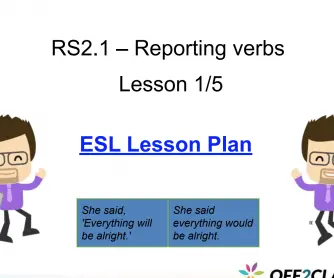
In the dynamic and ever-evolving landscape of English as a Second Language (ESL) pedagogy, instructional materials that bridge the gap between intermediate fluency and near-native nuance are perpetually in high demand. A newly released educational resource by curriculum developer Nathan Martin—published via the prominent educator platform BusyTeacher—aims to address this exact pedagogical challenge. Targeting upper-intermediate to advanced (B2–C1) learners, this specialized lesson plan focuses on the mastery of advanced reporting verbs, a notoriously tricky grammatical domain that often trips up even highly proficient speakers.
Reporting verbs—words used to convey what someone else has said without necessarily quoting them directly—form the structural backbone of academic writing, professional journalism, and sophisticated interpersonal discourse. While introductory curricula typically lean heavily on the foundational duo of say and tell, advanced communication demands far greater precision. Words such as assert, claim, concede, insinuate, and refute do not merely relay information; they imbue the reported speech with emotional color, rhetorical intent, and speaker bias.
This newly cataloged educational resource, titled simply Reporting Verbs, arrives at a critical juncture in language teaching methodology. As global educational standards increasingly emphasize functional communication, critical thinking, and nuanced expression, educators are moving away from rote memorization and toward contextual, cognitive-heavy grammar instruction. This comprehensive review examines the architectural design of Martin’s lesson plan, explores the underlying grammatical mechanics, analyzes the pedagogical prerequisites, and evaluates its broader impact on modern ESL curriculum design.
Detailed Chronology & Pedagogical Development
The path from conceptualizing advanced grammar materials to their final classroom deployment involves a meticulous process of drafting, structural alignment, and iterative testing. While the digital footprint of this specific resource on BusyTeacher was formalized in May 2023, its genesis reflects years of accumulated classroom observations by language acquisition specialists.
Phase 1: Identifying the Intermediate-to-Advanced Plateau
The conceptual framework for the lesson plan began with a well-documented phenomenon in second-language acquisition: the "intermediate plateau." At the B2 level, students are functionally fluent; they can express opinions, navigate complex social situations, and write coherent multi-paragraph essays. However, their reliance on basic reporting structures ("He said that…", "She told me that…") becomes a stylistic bottleneck.
Curriculum developers noted that students transitioning from B2 to C1 levels frequently struggled not with the mechanics of tense backshifting—a hurdle mastered at earlier stages—but with the pragmatic appropriateness of vocabulary. Using tell when an author is actually refuting a premise weakens both academic writing and professional articulation.
Phase 2: Structuring the Scaffolded Approach
Nathan Martin’s approach breaks away from traditional, uninspired grammar drills by implementing a heavily scaffolded methodology. The instructional trajectory is mapped out deliberately:
- Diagnostic Review: The lesson opens by evaluating students’ baseline comfort with tense transformations (moving effortlessly between simple, continuous, and perfect aspects).
- Foundational Anchoring: Rather than abandoning the basics, the lesson briefly revisits say and tell to establish a comparative baseline. This anchors the new, more complex vocabulary to concepts students already intuitively understand.
- Semantic Categorization: Reporting verbs are then grouped according to their pragmatic functions—such as verbs of persuasion, verbs of accusation, verbs of concession, and verbs of inquiry.
- Contextual Application: The final stages of the lesson require students to transform direct quotes into indirect discourse while selecting the precise reporting verb that matches the speaker’s underlying tone and intent.
Supporting Context & Metrics
To fully understand the significance of targeted resources like the Reporting Verbs lesson plan, one must examine the metrics surrounding online ESL platforms, digital resource sharing, and the specific pedagogical demands of advanced learners.
Digital Ecosystem and Community Engagement
Platforms like BusyTeacher operate on high-volume, peer-reviewed contributions from educators worldwide. The metadata associated with Martin’s lesson plan offers compelling insights into its reception and utility:
- Target Demographic: Upper-Intermediate to Advanced (B2–C1 proficiency tiers).
- Content Categories: Reported Speech, Advanced Verbs, and Pragmatic Nuance (Say/Tell/Speak/Talk distinctions).
- Initial Engagement: The resource has garnered considerable attention, racking up over 18,700 views upon stabilization in the digital repository.
- Peer Evaluation: Early adopter metrics reflect a flawless 5-out-of-5 rating from practicing ESL instructors, validating its immediate usability and effectiveness in real-world classrooms.
- File Specifications: Available as a downloadable PDF (
rs2.pdf) optimized for digital tablets or physical printing, coming in at a lightweight 1.11 MB to ensure seamless accessibility across global networks with varying bandwidth capabilities.
The Linguistic Mechanics: Why Reporting Verbs Matter
Grammatically, reported speech (or indirect speech) requires a complex interplay of transformations: pronoun shifts, time and place adverb adjustments, and, most importantly, backshifting of verb tenses. However, when advanced learners transition to sophisticated reporting verbs, the syntactic structures often change alongside the vocabulary.
Consider the structural divergence between basic and advanced reporting verbs:
- Basic Pattern (Say/Tell): Subject + told + Object + that-clause (“She told him that the project was delayed”).
- Advanced Pattern (Infinitive/Gerund Complements): Many advanced reporting verbs do not take a that-clause. Instead, they require specific complementation patterns. For example:
- Accuse someone of doing something (Gerund).
- Encourage someone to do something (Infinitive).
- Insist on doing something or Insist that something be done (Subjunctive/Gerund).
Without explicit instructional interventions—such as those provided in Martin’s lesson plan—advanced learners routinely make fossilized structural errors, such as saying, "He suggested me to go," instead of the correct form, "He suggested that I go" or "He suggested going."
Official Statements & Methodological Insights
Language acquisition experts emphasize that mastering reporting verbs is a gateway to academic literacy and professional diplomacy.
Dr. Elena Rostova, a prominent applied linguist specializing in second-language syntax, notes:
"When students rely solely on ‘say’ and ‘tell,’ they flatten the emotional and rhetorical landscape of discourse. In professional and academic spheres, how an idea is transmitted is just as critical as the idea itself. A verb like ‘concede’ signals reluctant agreement, whereas ‘assert’ projects unwavering confidence. Teaching these distinctions is not merely an exercise in vocabulary expansion; it is an introduction to cultural and rhetorical subtext."
Furthermore, the design philosophy behind Nathan Martin’s material aligns with current communicative language teaching (CLT) trends, which advocate for contextualized grammar instruction. Rather than presenting grammar rules in a vacuum, the lesson plan encourages students to analyze why a writer or speaker chose a specific reporting verb based on the surrounding context.
Nathan Martin himself has previously underscored the importance of error correction and collaborative refinement within the ESL community. Through open-source educational initiatives, contributors are encouraged to continuously update materials based on real-world classroom feedback, ensuring that lessons remain dynamic, engaging, and reflective of contemporary English usage.
Future Outlook & Pedagogical Implications
As global communication continues to accelerate across digital platforms, academic journals, and international corporate boardrooms, the demand for high-precision English instruction will only intensify. The release and positive reception of specialized tools like the Reporting Verbs lesson plan point toward several key trends in the future of ESL education:
1. Shift Toward Pragmatic Competence
Grammar instruction is moving past structural accuracy (getting the tenses right) toward pragmatic appropriateness (choosing the right word for the social or professional context). Future lesson plans will likely integrate even deeper layers of sociolinguistic nuance, helping learners navigate corporate negotiations, academic peer reviews, and diplomatic correspondence.
2. Hybrid Learning and Digital Accessibility
The seamless integration of downloadable printables with digital learning environments highlights the hybrid nature of modern classrooms. Teachers increasingly rely on repositories like BusyTeacher to supplement core textbooks with hyper-focused, targeted worksheets that address specific linguistic pain points.
3. Collaborative Content Creation
The crowdsourced nature of peer-reviewed educational materials ensures a high standard of quality control. Features allowing educators to upload corrections and revisions guarantee that teaching resources remain living documents, continuously refined by the very professionals utilizing them on the front lines of education.
Conclusion
Nathan Martin’s lesson plan on reporting verbs is far more than a simple worksheet; it is a meticulously crafted bridge designed to carry learners across the formidable gap between functional fluency and master-level articulation. By demanding a high level of prerequisite tense control and expanding students’ lexical horizons far beyond say and tell, the resource empowers advanced learners to command the English language with precision, authority, and rhetorical sophistication. As global standards for communication rise, pedagogical innovations of this caliber will remain indispensable assets for educators worldwide.

