
Executive Overview
In the modern educational landscape, the integration of digital tools into daily classroom routines is no longer a futuristic vision—it is an operational necessity. As school districts nationwide pivot toward mandatory digital testing frameworks, educators face the dual challenge of modernizing legacy testing materials and fostering a learning environment where continuous student growth can be accurately measured and accelerated.
A compelling case study in bridging this technological gap comes from Zenith Accelerated Academy in Orlando, Florida. Debbie Bohanan, a dedicated Video and Media teacher, has long championed digital formative assessments. Over a decade of leveraging Kahoot! in her instructional design, Bohanan has generated more than 2,100 individual assessment reports, establishing a data-driven culture in her classroom.
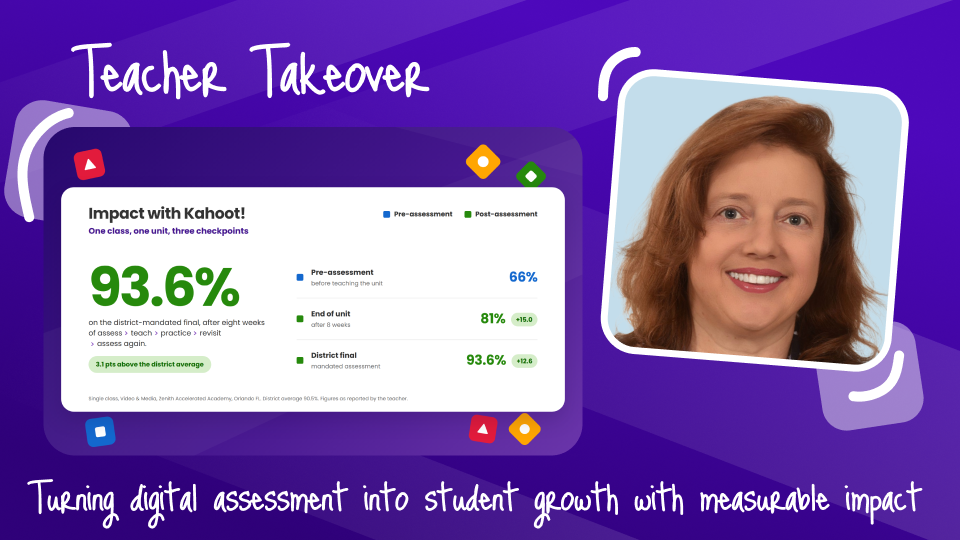
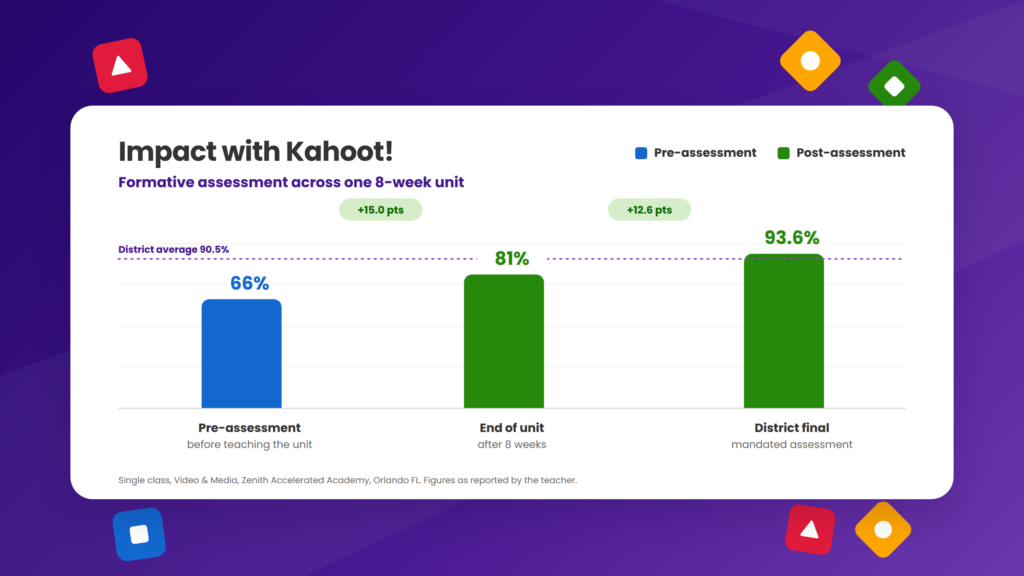
When her school district mandated that all end-of-year assessments be transitioned to digital formats for the 2025–26 academic year, Bohanan’s classroom was uniquely positioned for a seamless transition. By marrying innovative edtech solutions—specifically PDF question extraction—with a rigorous, cyclical instructional framework, she achieved remarkable outcomes. Her students logged a dramatic progression in performance, moving from a 66% baseline on initial pre-assessments to an 81% average after eight weeks of targeted instruction, culminating in an impressive 93.6% class average on the district-mandated final assessment. This final metric placed her students 3.1 percentage points above the broader district average.
This report investigates the methodology, technological efficiencies, and instructional philosophy that underpinned Bohanan’s success, offering a blueprint for educators navigating the digital assessment revolution.
Detailed Chronology: From Baseline to Benchmark
The journey toward academic excellence in Bohanan’s classroom was built on a deliberate, step-by-step instructional cycle: Measure, Teach, Practice, Revisit, and Re-assess.
Phase 1: Establishing the Baseline
At the inception of the instructional unit, Bohanan administered a comprehensive pre-assessment. Her students recorded an initial class average of 66%. Rather than viewing this score as an indictment of student knowledge, Bohanan treated it as a vital baseline.
Because Kahoot! was already embedded in her daily classroom culture, students encountered zero technological friction. They were entirely familiar with the mechanics of digital question-and-answer formats, immediate feedback loops, and interactive review modules. This absence of a learning curve allowed Bohanan to pivot instantly to diagnostic analysis: isolating specific conceptual gaps, identifying areas requiring immediate reinforcement, and mapping out the subsequent eight weeks of instruction.
Phase 2: The Eight-Week Instructional and Practice Cycle
Over the ensuing two months, learning was treated as an ongoing, iterative process rather than a race to a single exam. Bohanan integrated key curriculum content repeatedly through direct instruction, interactive classroom review sessions, and asynchronous, assigned game experiences.
Instead of relying on high-stress, last-minute cramming sessions before an exam, students engaged in spaced repetition. They encountered core concepts across multiple contexts, strengthening memory retention and cognitive flexibility. By the conclusion of this eight-week period, a follow-up review assessment revealed that the class average had surged to 81%—representing a significant 15-percentage-point gain from the initial baseline.
Phase 3: Overcoming the Paper-to-Digital Hurdle
A critical logistical hurdle in this pedagogical journey involved the district’s official 50-question summative assessment. Because the test was utilized for standardized district-wide reporting, the questions had to maintain absolute fidelity to the original language and structure that students would encounter on the official exam.
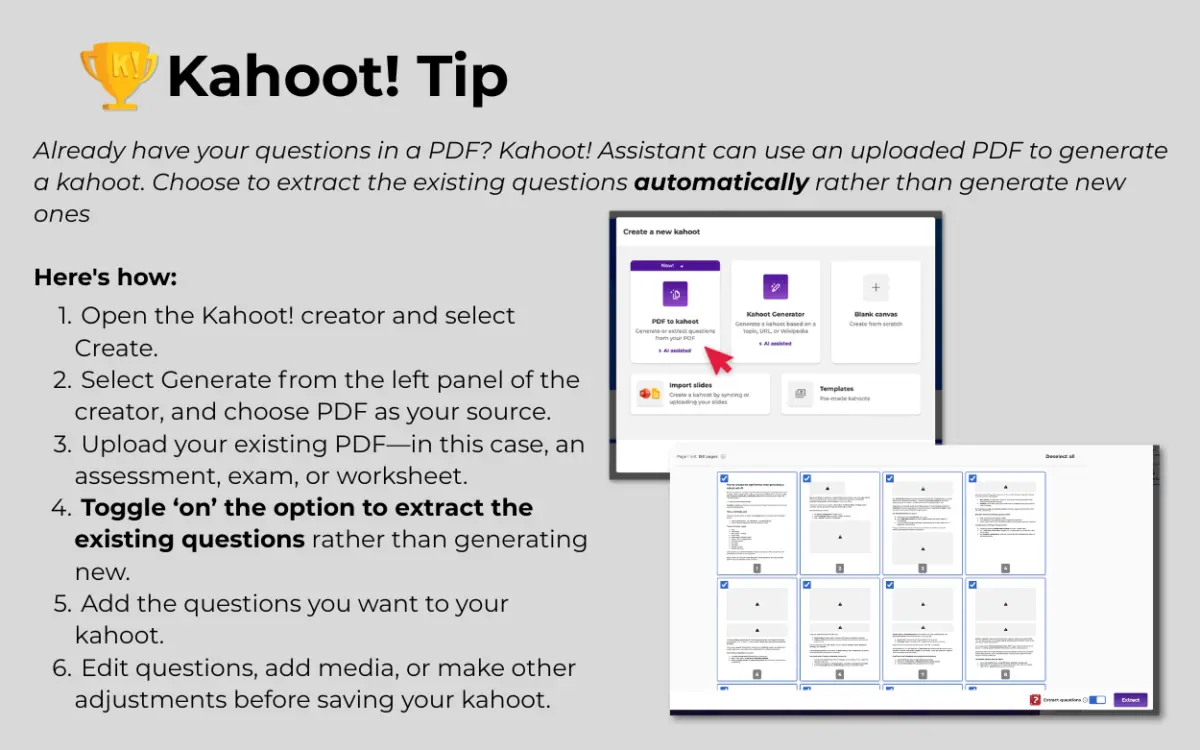
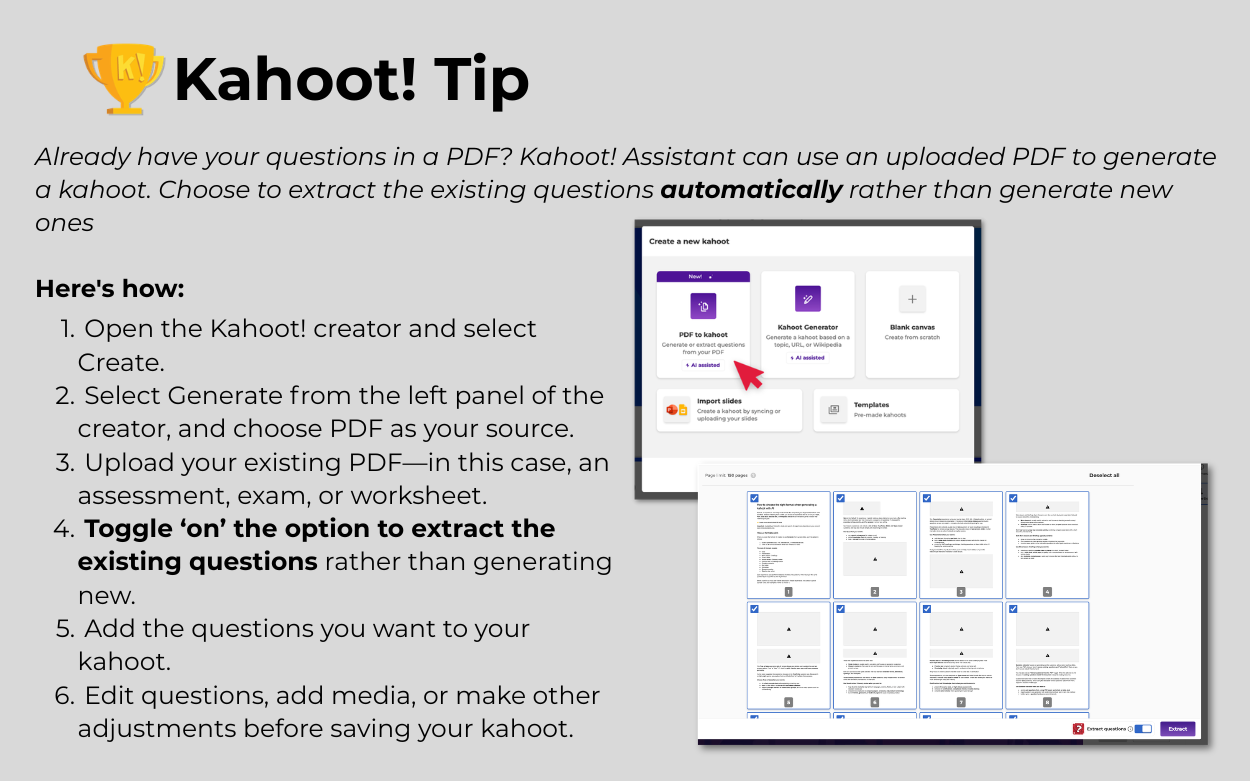
Manually transcribing a 50-question standardized test into a digital quiz platform would have demanded countless hours of painstaking labor across multiple planning periods and after-hours sessions. To solve this efficiency bottleneck, Bohanan utilized Kahoot!’s advanced PDF question extraction capability.
By uploading the pre-existing paper-based assessment document as a PDF, Bohanan successfully transformed the static questionnaire into an interactive digital learning experience in a matter of seconds. This technological shortcut preserved the exact lexical structure and nuanced wording required by district standards while injecting the engagement, interactivity, and flexibility of digital gameplay into the review process.
Phase 4: Extending Learning Beyond the Classroom Walls
The learning cycle did not terminate when the school bell rang. By leveraging asynchronous game modes, Bohanan enabled her students to continue studying and reviewing course material independently outside of instructional hours.
This out-of-class engagement transformed passive homework into active cognitive retrieval. Students could revisit difficult questions at their own pace, pinpoint lingering knowledge gaps, and build robust familiarity with complex multimedia concepts. This continuous feedback loop reinforced the core pedagogical rhythm:
$$textAssess longrightarrow textTeach longrightarrow textPractice longrightarrow textRevisit longrightarrow textRe-assess$$
Phase 5: The Summative Achievement
The culmination of this systematic approach materialized during the administration of the district-mandated end-of-year assessment. Bohanan’s students achieved a stellar 93.6% class average, outperforming the broader district average of 90.5% by 3.1 percentage points. This marked a striking total progression of nearly 28 percentage points from their initial 66% baseline.
Supporting Context & Metrics
To fully comprehend the significance of these results, it is essential to examine the quantitative trajectory alongside the qualitative shifts in classroom dynamics.
Quantitative Breakdown
- Initial Baseline (Pre-Assessment): 66% class average.
- Mid-Unit Progression (Post-Instruction): 81% class average (a 15-percentage-point increase).
- Final Summative Assessment: 93.6% class average.
- District Benchmark Comparison: 3.1 percentage points higher than the district average (90.5%).
- Historical Integration: Over 2,100 individual Kahoot! reports generated over a decade of teaching practice.
The Power of Technological Efficiency
The integration of PDF question extraction highlights a vital evolution in educational technology: reducing administrative overhead for teachers. Educators are frequently overwhelmed by non-teaching administrative tasks, such as digitizing legacy paper exams. By compressing hours of manual data entry into seconds, tools like the PDF question extractor allow educators to reallocate their most precious resource—time—back into direct student interaction, lesson planning, and individualized support.
Furthermore, the data collected from thousands of digital reports provided Bohanan with granular insights into specific student missteps. Instead of guessing which media theory or technical video production concept caused widespread confusion, she could pull precise analytics reports showing which questions had the lowest success rates, tailoring her review sessions accordingly.
Official Perspectives and Institutional Ripple Effects
While statistical metrics offer a rigorous snapshot of academic success, the broader institutional impact of Bohanan’s methodology is perhaps best measured by how her peers responded to her achievements.
When fellow educators at Zenith Accelerated Academy observed the rapid, measurable progress of Bohanan’s students, interest quickly turned to emulation. Colleagues approached her to request access to her pre- and post-assessment formats, asking how they could replicate her instructional workflow within their own classrooms.
This organic dissemination of best practices underscores a crucial tenet of modern educational leadership: successful pedagogical frameworks must be scalable and shareable. Bohanan did not merely optimize her own classroom; she inadvertently engineered a replicable district model. By establishing a familiar digital assessment routine, aligning review materials seamlessly with standardized benchmarks, and prioritizing repeated student exposure, she developed a blueprint that transcends a single subject area or grade level.
Educational analysts note that this peer-to-peer adoption validates the core thesis of the case study: technology yields the highest dividends when it serves a clear, intentional pedagogical strategy rather than being deployed as a mere novelty.
Future Outlook: The Evolution of Classroom Assessment
As school districts nationwide continue to grapple with the demands of digital transformation, standardized testing, and data privacy, the experience of educators like Debbie Bohanan offers a clear window into the future of teaching and learning.
The traditional paradigm of assessment—where testing is viewed strictly as a punitive or terminal judgment at the end of a unit—is rapidly giving way to continuous, formative assessment ecosystems. In these modern classrooms, assessments function as navigational instruments. They are diagnostic tools designed to reveal student thinking in real-time, guide instructional adjustments, and empower learners to take ownership of their academic trajectories.
Moving forward, the integration of advanced edtech features, such as automated PDF parsing and AI-assisted question generation, will likely become standard across K-12 and higher education institutions. However, technology alone cannot drive student growth. The true catalyst remains the intentional teacher who uses data not merely to grade students, but to decide what instructional steps to take next.
Debbie Bohanan’s success at Zenith Accelerated Academy serves as an authoritative reminder: when intuitive digital tools are paired with expert instructional design, assessment ceases to be a stressful administrative hurdle. Instead, it transforms into a powerful catalyst for student engagement, confidence, and measurable academic excellence.

