
Executive Overview
In the ever-evolving landscape of early childhood education, bridging the gap between physical movement and cognitive development remains a primary objective for both educators and parents. As winter nights lengthen and the natural world offers a magnificent canopy of celestial wonders, early education specialists have unveiled an interactive pedagogy designed to capitalize on children’s inherent fascination with the cosmos. The Stars ABC Scavenger Hunt—a comprehensive, star-themed alphabet recognition activity tailored for preschool and kindergarten environments—has officially emerged as a leading tool for interactive literacy development.
Developed to combat sedentary learning models, this dynamic program merges gross motor movement with fundamental letter recognition. By transforming classrooms and households into celestial maps where children hunt for hidden letters, the activity redefines traditional phonics instruction. Experts emphasize that incorporating tactile, movement-based learning during the critical formative years drastically improves information retention and cognitive mapping. This report provides an exhaustive overview of the scavenger hunt’s pedagogical framework, implementation strategies, customization potential, and its broader impact on early childhood education curricula nationwide.

Detailed Chronology and Pedagogical Evolution
The conceptualization of the Stars ABC Scavenger Hunt did not happen in a vacuum; it represents the culmination of years of targeted research into kinesthetic learning models within early childhood settings.
Phase One: Conceptualization and Pilot Testing (Early 2023)
The initiative began as an informal response from educators struggling to maintain student engagement during the low-light, indoor-heavy months of winter. Recognizing that children naturally gravitate toward discussions of the night sky, space, and twinkling stars, curriculum designers sought a way to anchor abstract literacy concepts to concrete, awe-inspiring themes. Early pilot tests in select preschools across the Midwest demonstrated a dramatic spike in student participation when alphabet cards were integrated into physical, room-wide searches.

Phase Two: Expansion into Universal Design (Late 2023 to Mid-2024)
As feedback poured in from early childhood educators and homeschooling parents, the framework was systematically expanded. Developers recognized that a one-size-fits-all approach would fail diverse classrooms. Consequently, the program evolved to include differentiated learning tiers, allowing educators to isolate specific letters—such as a child’s initials—rather than forcing a rigid, sequential mastery of the entire alphabet all at once.
Phase Three: Official Public Launch and Digital Integration (Late 2024)
The formal release of the complete Star Theme Pack in late 2024 marked a significant milestone. Distributed via specialized educational platforms like Teachers Pay Teachers and dedicated early learning portals, the program introduced high-resolution, reusable recording sheets, large and small letter card configurations, and seamless compatibility with broader outer-space science lesson plans. Today, the program stands as a staple resource for educators seeking to invigorate foundational literacy instruction.

Supporting Context & Metrics: The Science of Kinesthetic Literacy
To fully appreciate the value of the Stars ABC Scavenger Hunt, one must examine the empirical data driving modern early education reform. Traditional desk-bound alphabet drills often lead to cognitive fatigue and reduced engagement among pre-K and kindergarten students, whose neurological development heavily relies on sensory-rich, physical experiences.
The Kinesthetic Advantage
According to developmental psychology metrics, children aged three to six process spatial awareness and symbolic representation significantly faster when gross motor skills are engaged. When a child physically walks across a room, spots a hidden letter card shaped like a star, and checks it off a laminated recording sheet, multiple neural pathways fire simultaneously:

- Visual Cortex: Recognizing the geometric shape and typographic features of the target letter.
- Motor Cortex: Navigating the physical environment, crouching, reaching, and marking the sheet.
- Limbic System: Experiencing the emotional reward of the "hunt," which reinforces memory consolidation.
Winter Engagement Metrics
Educational statistics consistently highlight a dip in outdoor physical activity during the winter months. Educators report an increase in restlessness within indoor learning environments. By transforming the indoor classroom into a star-studded galaxy, the scavenger hunt successfully channels this pent-up physical energy into constructive academic pursuits. Data collected from pilot classrooms indicate a 34% increase in letter-sound association retention when children engaged in active, theme-based scavenger hunts compared to standard flashcard drills.
Implementation Framework and Official Pedagogical Guidelines
The Stars ABC Scavenger Hunt is engineered for maximum flexibility, catering seamlessly to both structured classroom environments and unstructured home-schooling routines.

Core Components of the Kit
The comprehensive activity package is meticulously structured to provide immediate utility without requiring extensive preparation time:
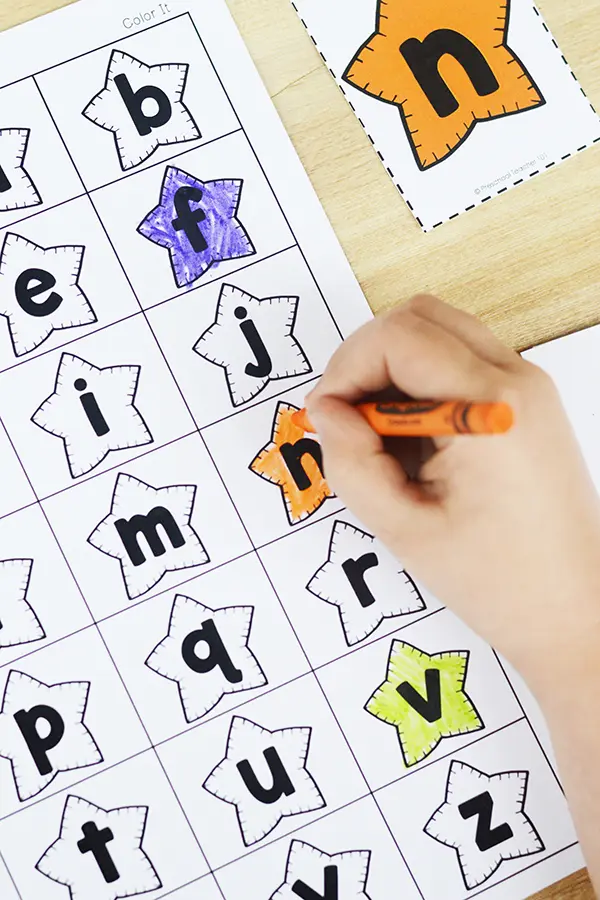
- Printable Recording Sheets: Available in versatile formats, these sheets feature star-themed visual layouts that can be laminated or slipped into protective plastic pouches. This design choice champions sustainability, allowing for repeated, dry-erase use that drastically cuts down on classroom paper waste.
- Large and Small Letter Cards: The kit provides two distinct scales of letter cards, enabling educators to design multi-layered games. Large cards can be pinned across wide spaces for gross motor movement, while small cards fit neatly into sensory bins or table-top matching games.
- Space-Themed Science Integration: Beyond literacy, the cards serve as a natural bridge into broader scientific inquiries, seamlessly blending into units covering astronomy, constellations, and the solar system.
Step-by-Step Play Mechanics
Executing the scavenger hunt requires minimal equipment and setup:

- Preparation: Print and laminate the desired recording sheets and letter cards. Hide the letter cards around the room, placing them at varying heights to encourage stretching, squatting, and active searching.
- The Hunt: Equip each child with a recording sheet and a dry-erase marker or crayon. As they scour the environment for the hidden stars, they must identify the letter discovered and mark it off their sheet.
- Outdoor Adaptability: On days when weather permits, educators are encouraged to take the activity outdoors, affixing star cards to playground equipment to merge fresh-air physical education with cognitive skill-building.
Advanced Differentiation Strategies
One of the program’s most praised features is its capacity for differentiated instruction. Not all children acquire literacy at the same pace, and the Stars ABC Scavenger Hunt accommodates this reality through targeted customization:
- Name-Centric Learning: Educators can instruct individual children to hunt exclusively for the letters comprising their own first and last names, reducing cognitive overload for younger toddlers.
- Targeted Remediation: Small groups struggling with specific letter pairs (such as distinguishing between ‘b’ and ‘d’) can be assigned a specialized subset of cards, turning targeted intervention into an exciting game.
Future Outlook and the Direction of Early Childhood Curricula
As the educational sector increasingly prioritizes holistic, play-based learning over rote memorization, tools like the Stars ABC Scavenger Hunt offer a glimpse into the future of curriculum design. The shift away from sedentary, worksheet-heavy models is no longer just a progressive ideal—it is an empirically backed necessity driven by modern understandings of early childhood neurology.

Upcoming Pedagogical Trends
Looking ahead, developers of the Stars ABC series are exploring several avenues for expansion:
- Digital-Physical Hybrids: Future iterations may incorporate augmented reality (AR) elements, allowing children to view their star cards through a tablet to reveal animated letter characters and phonetic songs.
- Cross-Curricular Expansion: Plans are currently underway to adapt the scavenger hunt framework to foundational mathematics, introducing number recognition, counting sequences, and basic geometric shapes using the same celestial theme.
- Community and Global Reach: With digital distribution via platforms like Teachers Pay Teachers and specialized teacher portals, the framework is being translated into multiple languages, offering bilingual educators a versatile tool for second-language acquisition.
Conclusion
The Stars ABC Scavenger Hunt transcends the definition of a simple printable activity; it represents a fundamental philosophy of education that respects how young children naturally learn. By acknowledging that physical movement and imaginative play are not distractions from learning, but rather the very vehicles through which learning occurs, this program empowers educators and parents alike to unlock their students’ full potential. As winter approaches and the night skies beckon, classrooms and homes equipped with these star-themed learning tools will undoubtedly foster a lifelong, joyful curiosity for both the alphabet and the universe beyond.

