The landscape of artificial intelligence is undergoing a profound structural evolution. For years, the paradigm of generative AI deployment was dominated by the pursuit of the singular, monolithic "frontier model"—a massive, all-encompassing neural network designed to ingest prompts, parse complex queries, and generate responses across virtually any human domain. However, as enterprise adoption shifts from static, conversational chatbots to dynamic, autonomous AI agents capable of executing multi-step workflows, the limitations of the single-model approach have become glaringly apparent. Monolithic models are often too slow, prohibitively expensive to run at scale, and inefficient when tasked with repetitive, granular operations.
Entering this breach is Nvidia with the release of Nemotron 3.5 Lightning, an open artificial intelligence model introduced on August 11. Rather than positioning Nemotron 3.5 Lightning as another general-purpose answer engine meant to rival the largest frontier models head-on, Nvidia has engineered the model to serve as a high-speed, highly specialized workhorse embedded deep within long-running AI agent systems.
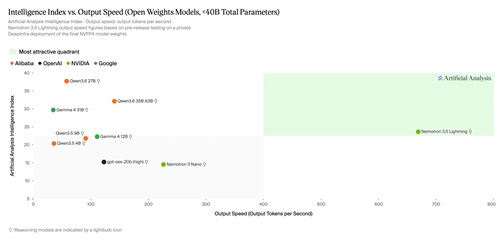
Boasting 30 billion parameters in a mixture-of-experts (MoE) configuration that activates a mere 3 billion parameters per token, Nemotron 3.5 Lightning is tailor-made for velocity. It supports sprawling context windows of up to 1 million tokens and delivers up to four times the output speed of comparably sized models. Crucially, Nvidia is making the model widely accessible through open weights, training data, and recipes under its OpenMDW-1.1 license.
Yet, the true significance of the Nemotron 3.5 Lightning release extends far beyond raw benchmarks or parameter counts. It signals a fundamental paradigm shift in how enterprise architectures will consume AI: moving away from the "one model to rule them all" philosophy and toward a collaborative system of models.
In this emerging framework, tasks are intelligently distributed among specialized models based on runtime requirements such as latency, cost, and task complexity. To operationalize this vision, Nvidia has simultaneously introduced NeMo Switchyard, an open-source routing library designed to dynamically direct requests across a heterogeneous mix of proprietary, open-source, and custom models without requiring application rewrites. Together, Nemotron 3.5 Lightning and NeMo Switchyard establish a blueprint for the future of enterprise AI—one where model selection is no longer a static, one-time platform choice, but a dynamic, real-time optimization challenge.
Detailed Chronology: The Evolution Toward Specialized Agents
To fully understand the strategic weight of the Nemotron 3.5 Lightning release, it is necessary to examine the trajectory of enterprise AI deployment over the past several years.
Phase 1: The Monolithic Chatbot Era (2022–2023)
Following the widespread public introduction of large language models (LLMs), enterprise adoption focused primarily on standalone applications. Businesses deployed massive foundation models to handle singular input-output pairs: summarizing documents, drafting emails, or answering customer support queries. In this era, raw intelligence and generalized knowledge retrieval were paramount. Organizations sought out the model with the highest benchmark scores, regardless of inference latency or cost, because the interaction was predominantly synchronous and human-facing.
Phase 2: The Rise of the Autonomous Agent (2024–2025)
As generative AI matured, developers sought to move beyond simple chat interfaces toward autonomous agents—software systems capable of breaking down high-level user goals into sequential tasks, invoking external tools (such as APIs, databases, and code interpreters), validating outputs, and iterating until a goal was achieved.
However, this architectural leap exposed a severe economic and operational bottleneck. When an AI agent executes a complex workflow, it may need to generate dozens, hundreds, or even thousands of intermediate model calls. Routing every single one of these steps—from high-level task planning down to rudimentary data formatting, string parsing, and syntax validation—through a massive, heavy frontier model introduces crippling latency and drives operational costs to unsustainable heights. An agent tasked with booking corporate travel or auditing financial ledgers cannot afford to wait seconds for a monolithic model to perform basic JSON formatting or tool-call verification.
Phase 3: The Multi-Model Ensemble Paradigm (August 2026 and Beyond)
Recognizing this bottleneck, Nvidia conceptualized an architectural decoupling. In an advanced AI agent system, workloads are partitioned.
The Reasoning Tier: A heavy, highly capable frontier reasoning model handles macro-level planning, complex strategic decisions, and ambiguous problem-solving.
The Execution Tier: A fleet of hyper-fast, specialized models handles the high-volume, repetitive micro-tasks—such as routine tool calls, data validation, syntax formatting, and sequential checks—that occur downstream of the primary plan.
The introduction of Nemotron 3.5 Lightning on August 11 marks the formal commercialization of this multi-model ecosystem approach. By providing a model explicitly optimized for high-speed execution rather than maximum generalized intelligence, Nvidia is supplying the missing link required to make large-scale, long-running enterprise AI agents economically and operationally viable.
Supporting Context & Metrics: Under the Hood of Nemotron 3.5 Lightning
Examining the technical specifications of Nemotron 3.5 Lightning reveals how Nvidia achieved its unprecedented balance of speed and efficiency.
Architecture and Parameters
Nemotron 3.5 Lightning is constructed as a 30 billion-parameter mixture-of-experts (MoE) model. Unlike dense models that engage all of their parameters for every single computation, MoE architectures utilize a router mechanism to dispatch tokens to a sparse subset of expert sub-networks. In the case of Lightning, only 3 billion parameters are activated per token. This design grants the model the broad knowledge capacity of a much larger network while retaining the computational footprint and execution speed of a much smaller model.
Context Window and Throughput
In enterprise settings, agents frequently need to ingest sprawling codebases, extensive legal documents, or deep historical logs. Nemotron 3.5 Lightning addresses this by supporting context windows of up to 1 million tokens, allowing agents to maintain long-range operational memory without suffering from context degradation.
When paired with its sparse activation scheme, this architecture enables the model to deliver up to four times the output speed of competing models in its size class. In rigorous enterprise testing, this velocity translates directly into reduced time-to-completion for multi-step agent workflows.
Efficiency Enhancements
To maximize inference efficiency across varied hardware deployments—spanning edge devices, enterprise data centers, and cloud environments—Nvidia incorporated several advanced optimization techniques directly into the model’s release:
Multi-Token Prediction: Allowing the model to forecast multiple future tokens simultaneously, drastically accelerating generation speeds during repetitive coding or text-generation tasks.
Speculative Decoding: Utilizing a smaller auxiliary draft model to propose token sequences that are then verified in parallel by the primary model, bypassing traditional autoregressive bottlenecks.
NVFP4 Quantized Checkpoints: Leveraging Nvidia’s cutting-edge low-precision data formats (such as 4-bit floating point representations) to reduce memory bandwidth requirements and accelerate inference throughput on compatible hardware accelerators without sacrificing acceptable accuracy thresholds.
Licensing and Openness
In a significant nod to the open-source and developer communities, Nvidia is offering Nemotron 3.5 Lightning under its OpenMDW-1.1 license. By releasing not just the model weights, but also the underlying training data and development recipes, Nvidia is empowering enterprise engineering teams to audit, fine-tune, and self-host the model securely within their own infrastructure boundaries—a critical requirement for finance, healthcare, and government sectors dealing with sensitive data.
Official Statements and Strategic Vision
Nvidia’s overarching philosophy regarding the transition from monolithic models to systems of models was detailed extensively in both their developer documentation and enterprise announcements accompanying the release.
According to Nvidia’s technical disclosures, modern enterprise AI agents are no longer solitary entities; they increasingly operate as model ensembles. In these complex topologies, different neural networks specialize in distinct operational domains.
"Raw capability remains an important metric, but latency, inference cost, deployment location, and task specialization are now converging into a single decision matrix," notes Nvidia’s enterprise engineering team. "A model that may not be the absolute strongest choice for abstract, high-level reasoning can still make profound economic and operational sense for a large volume of narrower, repetitive tasks—provided it can complete them with sufficient accuracy and blazing speed."
This perspective reframes how chief technology officers and lead architects must evaluate AI investments. Rather than asking, "Which single model performs best across every benchmark?" engineering teams must now ask, "How can we orchestrate a diversified portfolio of models to optimize the total cost, latency, and accuracy of our end-to-end workflows?"
The Role of NeMo Switchyard
To bridge the gap between this theoretical multi-model architecture and practical enterprise implementation, Nvidia released NeMo Switchyard concurrently with Lightning.
NeMo Switchyard is an open-source routing library engineered to sit as an intelligent traffic controller between enterprise applications and backend AI models. When an application generates a request, NeMo Switchyard evaluates the specific constraints of that request—such as required response quality, maximum tolerable latency, and cost ceilings—and dynamically routes it to the most appropriate model.
Crucially, Nvidia designed Switchyard to abstract away the underlying infrastructure complexity. Organizations can seamlessly route workloads across a hybrid mix of proprietary foundation models, open-source community weights, and specialized Nvidia models like Lightning, all without requiring engineers to rewrite the host applications making the requests.
Future Outlook: The Runtime Decision Revolution
The release of Nemotron 3.5 Lightning and NeMo Switchyard points toward an inevitable maturation point in the enterprise software lifecycle: the transition of AI model selection from a static, one-time platform procurement decision to a dynamic runtime operation.
1. Workflow-Centric Evaluation
As multi-agent systems become standard operating procedure across Fortune 500 enterprises, evaluation methodologies will shift away from isolated model benchmarks (such as MMLU or HumanEval scores) toward workflow-centric benchmarking. Engineering teams will measure the end-to-end performance, cost-efficiency, and error rates of entire agent pipelines, optimizing every link in the chain by assigning specialized models to specific operational nodes.
2. The Proliferation of Task-Specific Open Weights
Nemotron 3.5 Lightning is unlikely to remain an isolated phenomenon. As enterprises demand hyper-efficient execution tiers for agentic workflows, the demand for mid-sized, highly specialized, open-weight models will skyrocket. We can anticipate a proliferation of domain-specific models optimized not for general chat, but for specific agent sub-tasks: code generation, database querying, logical verification, and schema translation.
3. Intelligent Routing as Core Enterprise Middleware
As heterogeneous model deployments become the norm, intelligent routing libraries like NeMo Switchyard will evolve into mission-critical enterprise middleware. Companies will increasingly compete not just on the quality of their proprietary data or prompt engineering, but on the sophistication of their runtime routing algorithms—dynamically balancing cloud costs, API rate limits, and latency SLAs in real time as millions of autonomous agent calls ripple through their systems.
Conclusion
Nvidia’s Nemotron 3.5 Lightning is more than just a new entry in an overcrowded AI model marketplace. It is a calculated architectural statement. By recognizing that the future of AI belongs not to monolithic behemoths, but to agile, collaborative systems of specialized models, Nvidia has provided the enterprise community with both the high-speed workhorse and the orchestration tooling required to make autonomous AI agents faster, cheaper, and ready for prime-time industrial deployment.